New Kerr County History Book Available!

Tuesday, November 30, 2010

Then and Now: A School on Jefferson Street

There was once a school on Jefferson Street, at the intersection of Jefferson and Lemos Streets: the Our Lady of Guadalupe School.  I remember the old building when I was a boy, mainly for one feature.  It had a bell tower with a bell.  The building was in sad disrepair in the late 1960s, but I remember looking up at the tower and wondering about the bell.  When the building was torn down, would the bell be saved?
My guess is the bell was saved and is now one of the bells in the bell tower at Notre Dame Catholic Church on Water Street.
Here are two images of the old school, and one of the site today.
Click on any image to enlarge
Our Lady of Guadalupe School, Jefferson and Lemos Streets, Kerrville, around 1920
The building as it appeared in the late 1960s.  Note the bell in the left tower.
The site today, a self-storage facility.  Taken November 30, 2010.

Monday, November 29, 2010

History Detective: why are there two channels leaving the old mill? Part 2.

Click on any image to enlarge
Detail from April 1910 Sanborn-Perris Map of Kerrville, showing mill site.
Last week I wrote about the old mill below the 800 block of Water Street, and the remnants remaining there today. In the riverbed you can still spot where the old wooden posts formed the mill dam. You can still see some of the rock work for the old mill, and even a bit of the old mill race.
The mill itself was originally built by Christian Dietert in the 1850s, but over time it was changed and reconfigured. Water power was used by the settlers of our community to cut lumber, mill grains, and even gin cotton.
During work on my book of historic photos, I discovered two photos of discharge channels which I had originally believed showed the same channel. But on closer inspection I found they were of two separate channels.
Why, I wondered, did the mill have two channels for water being discharged from the mill's turbines?
I went to the site and checked out what I saw in the old photographs, and, sure enough, there were two channels cut into the chalky riverbed there. They ran parallel to each other, at an angle to the flow of the river, about 100 feet apart. They're visible, too, from the little observation platform Ed Hamilton has had built at the top of the bluff, right behind the fountain in the entryway to One Schreiner Center at the end of Washington Street.
I'll admit I spent some time down there trying to figure it out. I walked from one to the other several times, making sure what I saw in the historic photos was what I saw on the ground. It was true: there were two channels.
How the mills appeared in 1898, Kerville.
It took some research to figure it out, but here's my theory. There were two mills.
A close inspection of photographs taken between 1900 and 1920 definitely show two "water power shafts" rising from the mill dam to buildings built on the Water Street bluff.
The map shows the two "water power shafts" going to two separate buildings: one is labeled a "Gin," and the other a "Flour Mill."  The power shaft going to the gin also went to a "Dynamo Room," where, in 1910, electric power for Kerrville was generated.
The "gin" building is long gone, but I believe the basement of the "flour mill" building might still be here, and it's what Mr. Hamilton has built his observation point upon. Later it was an ice plant, and when I was a youngster, we explored the tunnels leading from the old ice plant toward Water Street.
If my research is correct, the two discharge channels served two separate turbines, meaning the settlers of our area "double-dipped" into the Guadalupe for power -- about 100 feet from each point -- and utilized that power in many different ways.
Joe Herring Jr. is a Kerrville native who is working on a book. This column originally appeared in the Kerrville Daily Times, November 27, 2010

Sunday, November 28, 2010

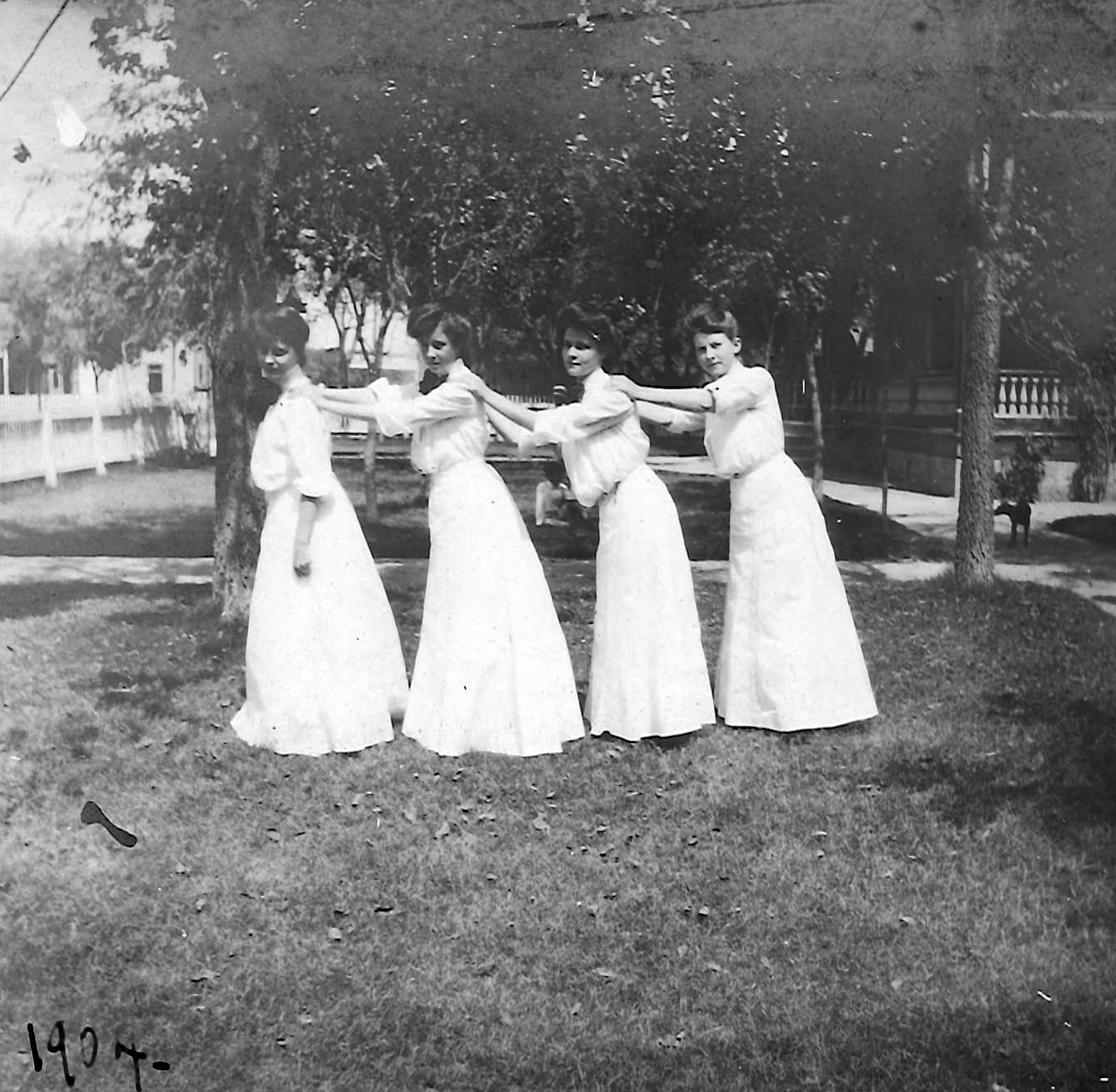
1904 Visitors to the St. Charles Hotel, Kerrville

The St. Charles Hotel was a grand hotel at the corner of Water and Tchoupitoulas streets in Kerrville. (Tchoupitoulas Street is now called Sidney Baker Street.)  The same corner later was the site off the Sid Peterson Memorial Hospital.
While many images of the old hotel exist, there are few showing visitors to the hotel.  A few years ago, Lanza Teague let me scan some images of a traveler's scrapbook which included photogaphs of the St. Charles, Pampell's, and other places from 1905 Kerrville, and showed tourists to Kerrville from that era.  These images, and over 200 others, are in my book.
Click on any image to enlarge.
Visitors to the St Charles Hotel, Kerrville, October 1905.

Virginia, Dorothy, and Margaret in front of Pampell's, Kerrville, 1905.

These three are darling. In front of Pampell's, which was opposite the
St Charles Hotel on Water Street, Kerrville, 1904-5

The four lasses, St Charles Hotel, Kerrville, 1904

The four lasses, St Charles Hotel, Kerrville, 1904

The four lasses, St Charles Hotel, Kerrville, 1904

Saturday, November 27, 2010

An apology. An explanation. And the hope to do better.

I have not been able to make regular posts to this blog over the past few weeks, and I wanted to apologize to the readers of this space.  I have been working on my book from early in the morning until late at night, during the hours when I wasn't at the print shop doing my regular paid job.
Something had to give, and it was this blog that suffered.
The book is now on the press and my editing work is finished.  So now I can devote more time to this space!  (The book is a "coffee table" book of photographs from my collection of historic photographs of Kerrville and Kerr County, 192 pages, hardcover, which will be on the shelves December 14th, but is available for pre-order by clicking here.)
I like sharing images and artifacts from my collection on this blog, and I've been consistently amazed at the interest (and traffic!) this little blog has received.  Thanks so much for your support in this project.
I hope to get back on a regular posting schedule, starting Sunday, November 28th.
I know consistency is important, and I want you (my fellow Kerrville history geeks) to depend upon this little blog for your Kerrville history fix!
All the best,
Joe

Monday, November 22, 2010

History Detective: why are there two channels leaving the old mill?

Ed Hamilton's recent efforts to spruce up the old mill site are really appreciated. For those that don't know, One Schreiner Center, in the 800 block of Water Street, is built approximately on the site of the old mill, where water power was harnessed to do many tasks in the early part of our community's history.
Ed built a small wall and a viewing area on top of what we used to call the Ice House foundations, and from that vantage point one can really enjoy a good view of the park and points south of the river. It's worth a visit.
Coincidentally, I have been spending a little time on the site as well, though down the bluff nearer the water. I've been trying to figure out a problem down there -- from something I discovered while going through some of the photos in my collection of historic photographs of Kerrville and Kerr County.
The old mill site was a very popular place to take photographs back at the turn of the last century. I have photos of couples down there, ladies with large hats, an entire classroom of students, boys, workers, and even the occasional tourist.
Two of the photographs show water as it's leaving the mill, long troughs of water heading back to the Guadalupe. These show the old wooden dam and then below, even below the apparent bottom of the dam, water in a little canal-like excavation, heading toward the Gulf of Mexico by way of Center Point and Comfort.
Channel Number 2
Channel Number 1
 Up until recently I thought those two images were of the same "trough."  But a closer examination revealed there were two of these watery exits from the mill on Water Street.
I wondered why there were two.
Most mills I've visited elsewhere have a big wheel positioned along the flow of the water; power is captured when the water falls to a lower level. The nearest example is in Gillespie County, between Doss and Hilda, Lange's Mill. It looks a lot like the picture-book mills: a rustic frame and stone structure with a large wheel; a mill pond above, a mill race, and then the spillway to the meandering Threadgill Creek below. (It's worth the drive to see the old mill, but be sure not to trespass.)  Lange's Mill has one of those nice 1936-style historical markers made of carved granite.
Kerrville's mill, on the other hand, didn't have one of those big, picturesque water-wheels, except at the very beginning.
Though it hasn't happened for a while, our section of the Guadalupe is subject to flooding -- sometimes great floods roar through here with the least remorse. A big water wheel would simply wash away, sometimes several times in one season.
Christian Dietert built the mill at the site, according to Bennett's history of our community. "In 1855 or 1856 Christian Dietert moved on up the Guadalupe and built another mill in the center of present day Kerrville. Capt. Charles Schreiner later acquired this mill property and eventually operated a sawmill, grist mill, cotton gin and flour mill."
According to the Kerr County Album, Dietert originally set up a water wheel, but it quickly washed away. "In 1868 Mr. Dietert put in an underwater iron turbine for power...."  That is consistent with the photos I have.
It doesn't, however, explain why there were two hand-dug channels for the water that exited the mill -- though I think I've figured it out. Unfortunately, this column has gotten a little long -- so I'll visit this subject next week, and supply what I think might explain the double channels.
Until then, all the best.
Joe Herring Jr. is a Kerrville native who is working on a book.  This column was originally published in the Kerrville Daily Times November 20, 2010. 

Sunday, November 21, 2010

Two rare photos of Kerrville stores

I have many photos of the outsides of buildings in my collection of historic photographs of Kerrville and Kerr County, but relatively few images of the insides, especially of the insides of commercial buildings.  These two are fine examples of this type of photograph.  I hope you enjoy them.
Click on any image to enlarge
A Kerrville hardware store.  If you have an idea where it was, I'd appreciate your comments below.
It took me awhile to realize it's a hardware store.  Upon inspection, I see tools lining the left wall.

The Poole-Clark mens' store.  These fellows could make anyone look sharp.
Courtesy Bryant Saner.

Friday, November 19, 2010

New Photo Caption Contest: Ends 11/21/10

Here's the Friday Photo Caption Contest!
The last contest was fun and the entries were quite humorous!  So here's this Friday's  "Write Your Own Caption" contest -- please provide a caption for this photo in the comments below.  (Comments on Facebook will not count in the contest, your entry must be in the comments below.)
I will be the sole judge of the contest, based on how humorous your entry is.  Please, no naughty captions -- this is a family blog, strictly rated G (or at worst PG).
Winner will receive a print of the photo plus the warm glow of victory and bragging rights.  Entries accepted through 11:59 p.m., Sunday, November 21st, 2010.  Enter as many times as you'd like.
Good luck!

This is an actual photo from my collection of historic photographs of Kerrville and Kerr County.
Click on image to enlarge
Enter your caption for this photo in the comments below!

AddThis

LinkWithin

Related Posts with Thumbnails