Don't miss a thing! Get free updates by email.

Tuesday, August 31, 2010

Louise Hays Park -- building a swimming hole.

I found another box of photographs in one of the seldom-visited nooks of the print shop this week; it was filled with some great photos.   Some of these images have never been published; most, when I received them, were impractical to prepare.  (I really love my new scanner which scans all types of photographs, even negatives!)  I hope you enjoy these.
These 4 images show men working to build what I assume was a swimming hole in the park.  I vaguely remember a diving board in this area when I was a child.  Of course, subsequent floods filled in the swimming hole with all sorts of debris and gravel.  The diving board is long-gone.  I thought you might like this glimpse of the work done in the park in the late 1950s.


Click on any image to enlarge
Building a swimming hole, Louise Hays Park, Kerrville, 1950s

Building a swimming hole, Louise Hays Park, Kerrville, 1950s
Arcadia Theater and Blue Bonnet Hotel in background.

Building a swimming hole, Louise Hays Park, Kerrville, 1950s

Building a swimming hole, Louise Hays Park, Kerrville, 1950s

The same scene, today.  Louise Hays Park, August 2010
  • To share these photos with your friends on Facebook, click here. I really want you to share these images.  The more people who can see these photos, the better!
  • To email this story and photos to your friends, click here.
  • To post a comment about this story, click here.
  • You can get email updates once a day when new articles are posted by clicking here.  Your email address is safe and will never be shared with any other website or organization.
  • To connect with Joe, please find him on Facebook at www.facebook.com/joeherring or on Twitter at www.twitter.com/joeherring


Monday, August 30, 2010

First Ever Photo Caption Contest

How about a contest?
It's my first "Write Your Own Caption" contest -- please provide a caption for this photo in the comments below.  (Comments on Facebook will not count in the contest, your entry must be in the comments below.)

I will be the sole judge of the contest, based on how humorous your entry is.  Please, no naughty captions -- this is a family blog, strictly rated G (or at worst PG).
Winner will receive a print of the photo plus the warm glow of victory and bragging rights.  Entries accepted through midnight, Monday, September 6th, 2010.
Good luck!

Click on photo to enlarge
First ever Photo Caption Contest.
Boys with firehose, Kerrville, late 1950s.
Click here to submit your entry!
  • To share these photos with your friends on Facebook, click here. I really want you to share these images.  The more people who can see these photos, the better!
  • To email this story and photos to your friends, click here.
  • You can get email updates once a day when new articles are posted by clicking here.  Your email address is safe and will never be shared with any other website or organization.
  • To connect with Joe, please find him on Facebook at www.facebook.com/joeherring or on Twitter at www.twitter.com/joeherring

New Photos from the 1950s of Life in Kerrville, part 2

I found another box of photographs in one of the seldom-visited nooks of the print shop this week; it was filled with some great photos.   Some of these images have never been published; most, when I received them, were impractical to prepare.  (I really love my new scanner which scans all types of photographs, even negatives!)  I hope you enjoy these.


Click on any image to enlarge
Is that fellow Gene Hutzler?  He'd better hope these 
Girl Scouts don't have a match -- he's standing in their fire.
Kerrville, 1950s

A group of boys with Fred Tally at Starkey Elementary, Kerrville 1950s.

Students with Fred Tally, Starkey Elementary cafeteria, Kerrville 1950s.

Something tells me this teacher has a wild class.
Tivy Elementary, Kerrville, 1950s


  • To share these photos with your friends on Facebook, click here. I really want you to share these images.  The more people who can see these photos, the better!
  • To email this story and photos to your friends, click here.
  • You can get email updates once a day when new articles are posted by clicking here.  Your email address is safe and will never be shared with any other website or organization.
  • To connect with Joe, please find him on Facebook at www.facebook.com/joeherring or on Twitter at www.twitter.com/joeherring

Sunday, August 29, 2010

New Photos from the 1950s of Life in Kerrville, part 1

I found another box of photographs in one of the seldom-visited nooks of the print shop this week; it was filled with some great photos.   Some of these images have never been published; most, when I received them, were impractical to prepare.  (I really love my new scanner which scans all types of photographs, even negatives!)  I hope you enjoy these.


Click on any image to enlarge
Part 1 of a "Closed System."
Game and Fish Commission staffer dumps fish
into the Guadalupe River, Kerrville, 1950s

Part 2 of a "Closed System."
Bobby and Jimmy catch the fish from Part 1.
Kerrville, 1950s.  Go back to Part 1.

Louise Hays Park.  Note the boat ride concession and the
Blue Bonnet Hotel in the background.

Water Ski Show, with four skiing beauties, Kerrville.
There were water ski shows in Louise Hays Park in the 1950s.


  • To share these photos with your friends on Facebook, click here. I really want you to share these images.  The more people who can see these photos, the better!
  • To email this story and photos to your friends, click here.
  • You can get email updates once a day when new articles are posted by clicking here.  Your email address is safe and will never be shared with any other website or organization.
  • To connect with Joe, please find him on Facebook at www.facebook.com/joeherring or on Twitter at www.twitter.com/joeherring

Saturday, August 28, 2010

The "Kerrville" or "Grey Gorge" Axe

Years ago, I asked for an axe.  Here's what I wrote in my column in the Kerrville Daily Times, back in 1999:
"Do you have an old “Kerrville” or “Grey Gorge” axe in the tool shed that you’d take the time to bring by the shop so I could see it? I’ve read about them several times over the years, and I’d like to see one – an invention truly born of necessity, born right here in Kerr County, years ago in the 1920s. I know it sounds impossible, but the cedar (Ashe juniper) trees that line our hillsides may be relative newcomers to the county. I’ve seen old photographs that suggest these hills we all so readily recognize were once covered very differently, and that trees (of any kind) in Kerrville were few and far between."
I asked for an axe, and my long-time friend John M. Mosty gave me his.  It's now part of my collection of Kerrville and Kerr County items.
The late Bob Bennett, in his history of the County, tells the following story:
“In the early twenties ranchmen of the cedar section of Texas began to hire cedar choppers to clear out the excessive growth, most of the choppers being migrant laborers from Mexico. These choppers complained that the axe in use was too heavy, weighing from three to four pounds. The handle was too long and the axe blade too short. These defects must be cured to create a more perfect cedar axe. Many were studying the problem and the solution was bound to be found sooner or later.
“Henry Weiss of Kerrville was interested in producing a better axe for cedar cutting than had thusfar been on the market. In cooperation with Frank Krueger, Kerrville blacksmith, who had learned his trade in Germany, a far better implement was evolved.”
At this point in his story, Bennett refers to an article written by Gene Hollon for the Southwestern Historical Quarterly, Volume L, No. 2, October 1946:
“The Charles Schreiner Company in Kerrville sold hundreds of axes each year to the cedar choppers, ranchers and farmers. The manager of the hardware store at that time was Henry Weiss, who was conscious of the need for an axe better suited to the cedar country. But he only ‘sold axes. He didn’t make them.’
Enter Frank Krueger.
“Krueger’s years of experience as a blacksmith, together with his mechanical turn, common to many Germans, qualified him to take Weiss’s suggestions and improve upon them.
“Using the Weiss-Krueger axe as a model, a manufacturing company began the making of the cedar axe in commercial quantities . . . The cedar axe immediately began to sell in large quantities, and is widely used today (1946). It is useful not only as a cedar cutter, but for cutting and trimming other green timbers. It is made in single blade and double blade styles. Experienced woodsmen say that the specially designed axe is twenty-five per cent more effective for the purpose of cutting cedar than the old style chopping axe . . . The double bladed cedar axe outsells the single blade product, according to dealers . . . .”

A "Kerrville" or "Grey Gorge" Axe.  Gift from John M. Mosty
* * *
Back in the days before concern for the golden-cheeked warbler (dendroica chrysoparia), eradicating the cedar (really juniper) trees was a prime objective of ‘scientific’ range management. This warbler supposedly uses the sloughing bark of the juvenile cedar for its nest, binding the long strips of bark into a cup-like shape with spider webbing. So today saving stands of cedar trees is in vogue, because the warbler is endangered. Yet only a generation ago, ridding the hillsides of cedar was government policy. Not only did the cedar crowd rangeland for livestock, it also had the reputation for drawing too much water from the soil. Many old reports say that after clearing cedar from a field, nearby streams began to flow again; the government at one time paid landowners to clear cedar. The cedar seemed to come with the livestock, taking over quickly areas newly fenced to maintain herds. Bennett’s book suggests that before the cattle and ranchers came, the local Indian’s habit of burning the “grassy ranges” helped control the advance of the cedar; I’d bet that the cattle’s degradation of the variety of plants on an already fragile soil helped break an opening for the shrubby pest, and with its pattern of spreading by seeds, ranchers had a big problem on their hands. The “Kerrville Axe” was a high-tech tool to battle the menace, and it was invented right here.
Joe Herring Jr. is a Kerrville native who is interested in very obscure things.

  • To share this story with your friends on Facebook, click here. I really want you to share these images.  The more people who can see these photos, the better!
  • To email this story and photos to your friends, click here.
  • You can get email updates once a day when new articles are posted by clicking here.  Your email address is safe and will never be shared with any other website or organization.
  • To connect with Joe, please find him on Facebook at www.facebook.com/joeherring or on Twitter at www.twitter.com/joeherring

Friday, August 27, 2010

The Tivy Football team that played for the State Championship

There was a Tivy football team that once played for the state championship -- the 1936 Tivy Antlers.  This was before there were divisions like 5A or 4A -- all the high schools across the state were eligible.  Tivy was undefeated and traveled to Amarillo to play the Amarillo Sandies.   Just about everyone in Kerrville went to the game -- a special train went from Kerrville to Amarillo -- and even Scrappy, a live white tail deer, rode the train.
I have a program from that game in my collection, along with a film of the game.
I'd like to report that Tivy won that game.  But they didn't, and became the second best team in the state.  No other Tivy team has made it so far in the state finals.  So far.....

Click on photo to enlarge
The 1936 Tivy High School football team, Kerrville, Texas

Here are the names of the players, courtesy of Frances "Fuzzy" Swayze:  Front row: (12) Earl Garrett (nephew to the person for whom the street is named), (24) Tommy Speakman, (29) Tommy Wren, (20) Nevil Mayeaux, (17) Willis Carlisle, (25) Frank Fisher, (13) Preston Chambliss, (31) William Coleman; Second row: Jerome Vanoy, Asst Coach, (32) Kyle Hollimon, (27) Hunter Rabalais, (11) Alfred Rust, (23) Alfred Coleman, (14) Chester Heiman, (18) Henry Hauser, (30) Charles Henke, (28) Walter Lee, (16) Roy Holbrook, Vernon Hilliard, Head Coach; Third row: Ernie Broussard, Mgr, (?) James Cherry, (21) ? Vetter, (20) Charles 'Slick' McCaleb, (10) Jack Paul, (15) Frank Shepperd.  Not pictured: Harry Schwethelm.


  • To share these photos with your friends on Facebook, click here. I really want you to share these images.  The more people who can see these photos, the better!
  • To email this story and photos to your friends, click here.
  • You can get email updates once a day when new articles are posted by clicking here.  Your email address is safe and will never be shared with any other website or organization.
  • To connect with Joe, please find him on Facebook at www.facebook.com/joeherring or on Twitter at www.twitter.com/joeherring

The last standing section of the old Sid Peterson Memorial Hospital

This should be down by Monday. Photo taken August 27, 2010.

Thursday, August 26, 2010

Kerrville children, carefree as a Norman Rockwell painting

 The theme for these four shots is children, and the simple life they led here in the late 1960s.  I recognize several people in these photos, but I'd appreciate any help you could provide.

Click on any image to enlarge
A field trip to the Kerrville Post Office, late 1960s.
Mrs. Margie Rollins on the far left; Glenn Meadows on the far right.

A boy and his dog, Kerrville, late 1960s.

Chidren with white tail doe.  The cat doesn't seem happy.

Good Turn Day, 1967, Kerrville.
  • To share these photos with your friends on Facebook, click here. I really want you to share these images.  The more people who can see these photos, the better!
  • To email this story and photos to your friends, click here.
  • You can get email updates once a day when new articles are posted by clicking here.  Your email address is safe and will never be shared with any other website or organization.
  • To connect with Joe, please find him on Facebook at www.facebook.com/joeherring or on Twitter at www.twitter.com/joeherring

Parade, Water Street, 1970s

I've been hopping around a bit on the time era for these photographs.  Here's a parade from the late 1970s, which shows downtown Kerrville as I remember it from my high school years.  On the corner, you can see the old Sid Peterson Memorial Hospital, then J C Penney's, and then Winn's.  I believe the parade was in either 1978 or 1979, and was celebrating Fire Prevention Week.

Click on any image to enlarge
Fire Prevention Parade, downtown Kerrville, late 1970s.
The Center Point Band is behind this vehicle from the Center Point VFD.

The Center Point Band, participating in a Fire Prevention Week Parade,
downtown Kerrville, late 1970s.

Fire Prevention Week parade, downtown Kerrville, late 1970s.

Fire Prevention Week parade, downtown Kerrville, late 1970s.
Note the businesses in the background.
  • To share these photos with your friends on Facebook, click here. I really want you to share these images.  The more people who can see these photos, the better!
  • To email this story and photos to your friends, click here.
  • You can get email updates once a day when new articles are posted by clicking here.  Your email address is safe and will never be shared with any other website or organization.
  • To connect with Joe, please find him on Facebook at www.facebook.com/joeherring or on Twitter at www.twitter.com/joeherring

Wednesday, August 25, 2010

Hula Hoop Craze Hits Kerrville, Part 2

Even quiet Kerrville is susceptible to national crazes and fads.   Here are photographs of a hula hoop contest on Earl Garrett Street, next to the Kerr County Courthouse.  I'm guessing these shots were taken during the 1950s, by A. C. Jorn.

Click on any image to enlarge
Hula Hoop Contest, Earl Garrett Street, Kerrville, 1950s

Hula Hoop Contest, Earl Garrett Street, Kerrville, 1950s

Hula Hoop Contest, Earl Garrett Street, Kerrville, 1950s

Hula Hoop Contest, Earl Garrett Street, Kerrville, 1950s
  • To share these photos with your friends on Facebook, click here. I really want you to share these images.  The more people who can see these photos, the better!
  • To email this story and photos to your friends, click here.
  • You can get email updates once a day when new articles are posted by clicking here.  Your email address is safe and will never be shared with any other website or organization.
  • To connect with Joe, please find him on Facebook at www.facebook.com/joeherring or on Twitter at www.twitter.com/joeherring

Hula Hoop Craze Hits Kerrville, Part 1

Even quiet Kerrville is susceptible to national crazes and fads.   Here are photographs of a hula hoop contest on Earl Garrett Street, next to the Kerr County Courthouse.  I'm guessing these shots were taken during the 1950s, by A. C. Jorn.

Click on any image to enlarge
Hula Hoop Competition, Earl Garrett Street, Kerrville, 1950s

Hula Hoop Competition, Earl Garrett Street, Kerrville, 1950s

Hula Hoop Competition, Earl Garrett Street, Kerrville, 1950s

Hula Hoop Competition, Earl Garrett Street, Kerrville, 1950s
  • To share these photos with your friends on Facebook, click here. I really want you to share these images.  The more people who can see these photos, the better!
  • To email this story and photos to your friends, click here.
  • You can get email updates once a day when new articles are posted by clicking here.  Your email address is safe and will never be shared with any other website or organization.
  • To connect with Joe, please find him on Facebook at www.facebook.com/joeherring or on Twitter at www.twitter.com/joeherring

Tuesday, August 24, 2010

Life in Kerr County Photographs, late 1960s.

Life here in Kerrville and Kerr County is like life anywhere: there are days of joy and days of pain.  Here are four photographs from the late 1960s which show a wide range of emotions, and reflect our community's effort to "bloom where we are planted," with the lot that has befallen us.


Click on any image to enlarge
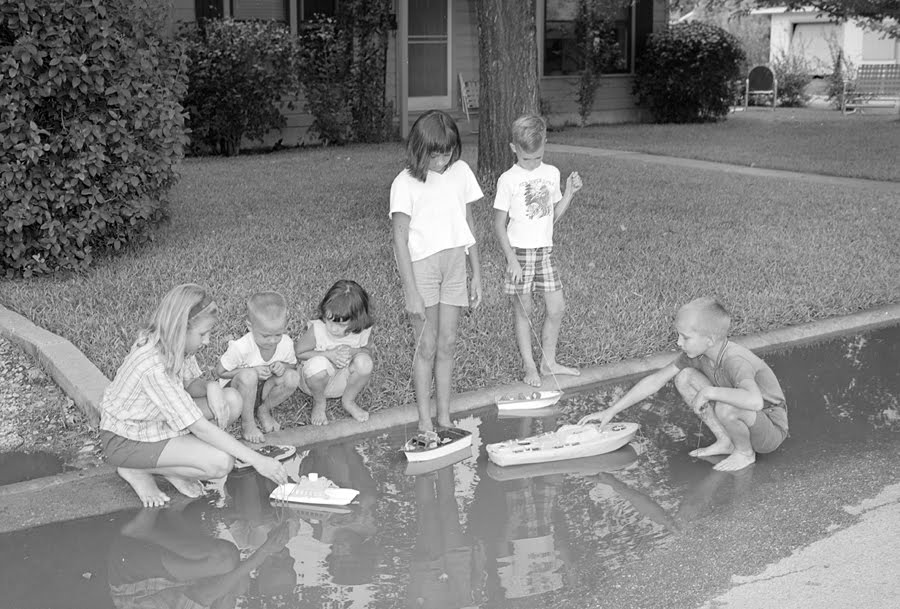
We play together.  Children with boats after a rain, 1968.

We grieve together.  Tommie and Doris Chenault, parents of
Robert Glenn Chenault, recieve his medals
after he was killed in Vietnam, 1968

The young lady is Valna Sauer Cox, who was engaged to Glenn.

We work together.  Furnishing a new school, 1968.

We volunteer together.  Lions Club members, 1968.

We build together.  Tom Daniels and Carlos Sneed plant a tree
at the new Tom Daniels Elementary campus, 1968.
  • To share these photos with your friends on Facebook, click here. I really want you to share these images.  The more people who can see these photos, the better!
  • To email this story and photos to your friends, click here.
  • You can get email updates once a day when new articles are posted by clicking here.  Your email address is safe and will never be shared with any other website or organization.
  • To connect with Joe, please find him on Facebook at www.facebook.com/joeherring or on Twitter at www.twitter.com/joeherring

Tivy High School photos, 1968

I found an envelope full of shots from 1968, many from Tivy High School.  I recognize some of the people in the photos, but could sure use some help in identifying them.

Click on any image to enlarge
Tivy Boy's Basketball, 1968 
From left: Willie Bratcher, Clifton Fifer, Coach Jim Reid, 
Gary McCormick and Ben Scharnberg

Tivy Choir, 1968

Tivy Coach with Football Players, 1968
from left: Coach Bill Farrington with seniors 
Tommy Pickens (QB) and Donnie Evans (linebacker)
  • To share these photos with your friends on Facebook, click here. I really want you to share these images.  The more people who can see these photos, the better!
  • To email this story and photos to your friends, click here.
  • You can get email updates once a day when new articles are posted by clicking here.  Your email address is safe and will never be shared with any other website or organization.
  • To connect with Joe, please find him on Facebook at www.facebook.com/joeherring or on Twitter at www.twitter.com/joeherring


Blue Yodeler's Paradise, Jimmie Rodger's home in Kerrville.

Built in the 1920s, this structure is one of at least 3 which use this particular brick; the other 2 are the Fawcett home, across Main Street, and Pampell's, downtown.

Monday, August 23, 2010

Jimmie Rodgers in Kerrville

Jimmie Rodgers and
Will Rogers in Kerrville,
at Blue Yodeler's Paradise
I've often wondered, as I hurtle past it in my truck, heading to work, what life was like in Blue Yodeler's Paradise, the home of Jimmie Rodgers. Jimmie Rodgers, one of the early country music recording stars, lived in Kerrville from about 1929 to 1931. His house still stands, at the intersection of Main and Jackson, high on a hill overlooking town. The house, a two story with some Spanish influences is a beauty. For as long as I can remember, it has been owned by the Crittenden family.
Tony Navarra has done more than just wonder about life in that house back when Rodgers lived there -- he's done the legwork to find out what it was really like, talking to folks around town that remember Mr. Rodgers.
Most of you know Tony from his appearances on the stage, most recently in the title role of 'The Foreigner,' which played at Schreiner College to much acclaim. He's a fun guy, and a very quick wit. I didn't realize he was also an amateur historian, working to track down folks that knew Jimmie Rodgers.
Tony has interviewed a lot of folks, and he's done it to research Mr. Rodger's life -- seems like Tony's going to combine this research into a one-man dramatic presentation, which will be staged during the upcoming Jimmie Rodgers Jubilee.
Tony came by the other day, and I got to ask him some questions about his research and the upcoming show.
"The folks I've talked were anywhere from 5 to 30 years old when Jimmie Rodgers lived in Kerrville," he told me.
The memories they shared with Tony are interesting, ranging from memories of adults who remembered seeing Rodgers in Kerrville, to memories of children who were playmates of Anita Rodgers, the daughter of the singer.
Rodgers is remembered as generous, and a bit flamboyant. One of the memories Tony related to me was of a gaggle of children being taken to San Antonio to see the circus -- riding in a "big blue chauffeur-driven limosine."
Others remember Jimmie Rodgers picking and singing in front of Pampell's -- Mr. Pampell was the RCA record dealer for the city, and Rodgers helped promote records there. Cornelia Fawcett Stehling remembers Rodgers allowing her to record a song on a recording machine up at Blue Yodeler's Paradise.
"Did Rodgers ever perform at the Arcadia?" I asked.
"He performed twice to packed houses," Tony replied quickly, a man who knows his subject.

Dr. Kathleen Hudson
  • To share these photos with your friends on Facebook, click here. I really want you to share these images.  The more people who can see these photos, the better!
  • To email this story and photos to your friends, click here.
  • You can get email updates once a day when new articles are posted by clicking here.  Your email address is safe and will never be shared with any other website or organization.
  • To connect with Joe, please find him on Facebook at www.facebook.com/joeherring or on Twitter at www.twitter.com/joeherring

The Arcadia Theater in Kerrville

The Arcadia Theater, Kerrville, late 1920s
From Bryant Saner's collection
On the warm Tuesday evening of June 29, 1926, a flock of folks crowded into a newly built hall to watch the comedy film “Irene,” starring Colleen Moore. They were greeted with “cooled” air and a saga about the life of a poor, beautiful Irish lass whose dire economic circumstances obscure her royal lineage. She worked as a shopkeeper’s assistant, selling dresses. A local grandee had obtained the job for her there as a model; the villainous shopkeeper had demoted her to lowly clerk. During a grand fashion show, the grandee notes the absence of his protégé, storms to the dimly lit store, costumes the girl and returns with her to triumph, and eventually love – discovered on a rusting fire escape, outside the fashion show.
The scenes of the fashion show were “registered in subdued tones of the Techni-color process, a new idea which has recently been discovered by those who invented the method of color photography.” This probably explains the choice of this movie, a First National release, as the film for that particular evening. The film was in color.
“Irene” was the first film shown in the newly built Arcadia Theater.
The town was very proud of their new theater. There was an older movie house, the Dixie, near the corner of Washington and Water streets, on the northern corner. The Dixie is remembered for its wooden bleachers, where patrons tucked their feet up to avoid the rats that ran along the floor eating popcorn and nibbling on shoelaces. The Arcadia, by contrast, was a movie palace.
Built at a cost of $90,000, the new theater featured high-tech (for 1926) projection equipment (a pair of Powers projectors), a ‘Gardner Velvet Gold Fibre Screen,’ a Hillgren-Lane pipe organ, and seating capacity for 1,000. The building looked very different then: it featured a Spanish mission façade, and the 16x40 foot ‘arcade’ was accented with rough plaster and hand-hewn beams. In the ‘arcade’ was seven display cases.
Seating was also arranged differently than the seating many of us remember. In addition to the ‘orchestra’ and balcony seats, there were also eight loges with five chairs each. Smoking was allowed in the balcony seats only.

Water Street, Kerrville, late 1920s
The small stage (8 x 15 feet) was furnished with scenery from Volland Scenic Company of St. Louis, and included a “beautiful mountain and river scene, typical of the country surrounding Kerrville. It is a remarkable reproduction of nature, done in oil.” There was also an orchestra pit measuring 7 ½ x 25 feet; this was the home of the pipe organ.
The neon sign we see frantically flashing in the night sky is not the original sign for the theater. The first was about 15 feet high and extended six feet above the building, with 16” letters. The lighting flashed on and off at intervals, but was not neon; the coloring of the letters was done by placing ‘glass color hoods’ over the lamps, and red and green and amber were the predominate colors. There was a twinkling torch and a ‘flowing’ border driven by an electric motor.
The Bart Moore Construction Company built the building. Mr. Moore was also the president of the Kerrville Amusement Company, which owned the Arcadia and Dixie Theaters, and he would serve as the Arcadia’s first general manager.

Admission prices that first week of performances were 25 and 50 cents.
  • To share these photos with your friends on Facebook, click here. I really want you to share these images.  The more people who can see these photos, the better!
  • To email this story and photos to your friends, click here.
  • You can get email updates once a day when new articles are posted by clicking here.  Your email address is safe and will never be shared with any other website or organization.
  • To connect with Joe, please find him on Facebook at www.facebook.com/joeherring or on Twitter at www.twitter.com/joeherring

Sunday, August 22, 2010

My favorite building in Kerrville

I know, I know.  But please grant me this boon on my birthday.  Here's the one building in Kerrville where I've spent most of my life.  The work there has fed me, my family, and hundreds of employees over the 45 years since my parents bought Marvin Hunter's printing company.  Our shop is actually the fourth print shop in this building.  There has been a print shop in our building since at least the 1950s; there has been a print shop on this block since 1898.

Click on image to enlarge
Herring Printing Company, soon after my parents bought
J. Marvin Hunter's print shop in 1965.  The La Veda Shop is on the
far right of the building.  Mrs. Domingues, owner of the La Veda, was a milliner.
  • To share these photos with your friends on Facebook, click here. I really want you to share these images.  The more people who can see these photos, the better!
  • To email this story and photos to your friends, click here.
  • You can get email updates once a day when new articles are posted by clicking here.  Your email address is safe and will never be shared with any other website or organization.
  • To connect with Joe, please find him on Facebook at www.facebook.com/joeherring or on Twitter at www.twitter.com/joeherring

More Kerrville homes from the 1920s

In the 1920s, some unknown City of Kerrville employee went house to house, taking photographs of each major building for property tax purposes.  He also filled out a report on the house, including such information as the number of square feet, the building materials used, and the use of the structures.  Here are some of the images, from my collection of historic photographs of Kerrville and Kerr County.  These are interesting to me because they tell the story of how people lived during that time.  Not just the rich, the powerful, or the influential.  Everyone.  Occasionally a citizen is seen in the photographs -- children playing, mostly -- but even when the images are only of structures, they still tell a story, a tale that life here was much different then than it is now. Harder. Tougher.


Click on any image to enlarge
933 Bulwer, Kerrville, 1920s

1404 Broadway, Kerrville, 1920s

105 Barnett, Kerrville, 1920s

932 Barnett, Kerrville, 1920s
  • To share these photos with your friends on Facebook, click here. I really want you to share these images.  The more people who can see these photos, the better!
  • To email this story and photos to your friends, click here.
  • You can get email updates once a day when new articles are posted by clicking here.  Your email address is safe and will never be shared with any other website or organization.
  • To connect with Joe, please find him on Facebook at www.facebook.com/joeherring or on Twitter at www.twitter.com/joeherring

LinkWithin

Related Posts with Thumbnails