Don't miss a thing! Get free updates by email.

Thursday, June 30, 2011

Moving day for the Spicer Building from 433 Water in Kerrville

Today's the day the old Spicer building is moving from its original home at 433 Water in Kerrville to its new home beside Rails on Schreiner Street.
Click on any image to enlarge


The Spicer Building on the property which will be its new home.

For more information about Joe's book, which has over 200 historic photographs
 of Kerrville, please click here.

Wednesday, June 29, 2011

A publishing revolution.

Having a phone with a pretty good camera is interesting.  It allows you to record parts of your life, and the life of your community, with images.  Some I immediately post here (or on Facebook).  This is revolutionary, really.  Sometimes I post items we'd once consider "News."  Once only those with expensive equipment (cameras, darkrooms, printing presses) could "Publish" news.  Now anyone can, and with an inexpensive phone.  The trick, of course, is to publish things that are interesting.
This post is to demonstrate the ease of publishing -- and to encourage my readers to try their own hand at blogging.  If you have a blog, please put your blog's address in the comments section below.  I'd be interested in visiting your site, and also in writing a guide to some of the best local blogs.
Click on any image to enlarge
My weekend shoes, taken on the back porch at home.

As the sun sets, it turns our neighbor's balcony a fiery orange; its reflection shown here.

My grandmother, Annie Lee Herring, on her birthday last week.

A Father's Day gift from Elizabeth and Ben

A young buck in our front yard.  Man, that screen looks awful.

I accidentally hit the camera button on my phone.  But I like the photo.

For more information about Joe's book, which has over 200 historic photographs
 of Kerrville, please click here.

Tuesday, June 28, 2011

Downtown Kerrville Railroad Tracks update.

I stopped by the Schreiner building project this morning to measure the gap between the rails found there last week.  A number of you have reported the San Antonio & Aransas Pass Railroad was built on the standard scale -- so the rails should be 4 foot 8 1/2 inches apart.  Earlier I reported the rails found were 5  foot apart, so I went back this morning to re-measure.  The rails found are 5 foot apart.  I have a theory as to why these rails are spread farther than expected.  First, the rails were cut years ago when the foundation was poured for the expansion of the Schreiner department store, so the rails found last week are near that cut.  They might have "fanned" out a bit near the cut.  Secondly, a foundation of some type was poured nearly on top of the rails, which also might have caused them to spread a bit.
We'll know more soon, though; a workman there said more of the tracks should be uncovered soon, possibly as early as tomorrow, farther from the "cut" point, toward the corner of the lot.  When these are exposed I will take another measurement.
I also took these two additional images for you -- to better show you what was found.
Click on any image to enlarge
This rail was pulled out of the ground before anyone realized what it was.

Three rails still in place.  I measured the gap between the two parallel rails
 and it measured 5 foot even.

For more information about Joe's book, which has over 200 historic photographs
 of Kerrville, please click here.

Monday, June 27, 2011

A rare photo of a bygone time in Kerrville

Amazing historic items come across my desk every week, but a few weeks ago a very special photograph was given to me by two kind readers of this column.
Click on any image to enlarge
The photo -- around 1900, Kerrville, at the West Texas Fair Grounds.
It is a photograph taken at the West Texas Fairgrounds, of several "camps" of the Woodmen of the World, taken sometime around the turn of the last century. The West Texas Fairgrounds were in Kerrville, to the west of Town Creek, somewhere in the neighborhood of Hugo and Starkey Streets. The photo includes around 100 people, grouped for a portrait, in period dress.
Kerrville Camp
It is a wonderful image of a time and place, showing a crowd of folks looking solemnly at the camera. Smiles are few. These folks were serious. Most of the women are wearing straw hats -- most of the men are wearing felt hats, so I'm not exactly sure what time of year it is.
Centre Point Camp
The banners of two camps can be plainly seen; one from Kerrville and one from "Centre" Point.
The Woodmen of the World, as far as I can tell, was founded 1890 in Omaha, Nebraska by Joseph Cullen Root, as a fraternal and life insurance organization. It was designed to help protect families from the financial distress of the loss of a loved one.
It didn't take long for the organization to reach Kerrville; the "Cypress Camp No. 58" is mentioned in a front-page story in the "Kerrville Paper" on January 26, 1895.
Child on goat.
"The Woodmen held a meeting one night this week and the manner of gaining admittance into and the ceremony of opening the lodge or camp was overheard and witnessed by a 'profane,' who afterward to us the story.
"He says that each member of the camp carried a stick of stove wood to the meeting. Ascending the outside stairway, he gave three raps on the door, which alarm was answered in the manner from within, and the following conversation ensued:
"Inside Guard -- 'Who comes here?'
"Member outside responds in a low voice -- 'Wood.'
"Inside Guard adds -- 'Up.'
". . . throwing open the door the Inside Guard says: 'My brother, seeing you come prepared to wood up, you have my permission to enter.'
"This ceremony is called 'working his way into the camp.'
The story goes into great detail about the actions of the members once inside, noting that upon command from the presiding officer to "Wood Up!" the members place their wood upon a grate in the center of the room, which is later lit into a roaring fire.

Bored baseball players waiting to play
I noted at once, as did the writer in 1895, that it was unusual to build a bonfire in the second story of a downtown frame structure, and further noted that building described no longer exists -- perhaps it burned down long ago.
"Suppose the house should catch fire," the story asks, "and all the men inside, finding the only door of egress closely guarded by an officer having a sharp tomahawk in his hand, should be roasted alive?"
The writer, who seems also to have been an agent, answers like this:
"His untimely death would make his family rich . . . Each Woodman, having a death benefit certificate safely deposited with his wife at home, can take the risk of being burned alive, killed by a runaway horse, or shot to death on his way home by someone giving an alarm of fire by reckless shooting in the streets."

Race results that day
The true humor of the short piece comes at the end, when the writer noted that the lodge meeting took place in the building next to the post office, that no member of the Cypress Camp had ever been known to purchase stove wood, that Postmaster Enderle's woodpile is close to the fence, and although the postmaster kept his bucksaw busy, his woodpile never grew higher, even though he had surrounded it with barbed wire, and had recently lost two watch dogs to poison.
I have noticed, while visiting the Glen Rest cemetery next to Schreiner College grave markers that look like stumps, with the Woodmen of the World seal and the latin motto reading Dum Tacet Clamat, which I'm told roughly translates to "though silent he speaks," although I'm not sure.
Some of those buried there were no doubt in that upper room, their faces aglow in the bright fire before them, uttering in a low voice, "Wood Up."


I'm fairly certain the photo I have was taken between July 4, 1896 and July 3, 1908, because of the 45-star U. S. flag one of the gentleman is holding. The photo is black and white and measures 7 inches tall by 26 inches wide.

Some of the women.  Note their sashes.
I'm thankful for the gift of the photo -- and I've really enjoyed studying it. I'll post the photo, as well as some images of its detail, on my blog Monday morning. To see the photo, visit www.joeherringjr.com
Until next week, all the best.
Joe Herring Jr. is a Kerrville native who collects Kerrville historic items.  This column originally appeared in the Kerrville Daily Times June 25, 2011.
For more information about Joe's book, which has over 200 historic photographs
 of Kerrville, please click here.

Thursday, June 23, 2011

Railroad Tracks Found!

Ben Modisett of the Cailloux Foundation tweeted me a moment ago, letting me know they'd found something interesting behind the old Schreiner Company building.  I walked right over and saw they'd uncovered two sets of railroad tracks -- tracks that once served the old Schreiner Wool Warehouse building.  The tracks have rails 5 feet apart.  A railroad enthusiast might be able to tell me if that was the standard width of the San Antonio and Aransas Pass Railway lines.
I went into the trench with the track and touched it -- and imagined the wealth of wool and mohair that once traveled from the warehouse to markets around the world.
Click on any image to enlarge
The old railroad spur tracks, Kerrville, 700 Block of Water Street.
Another view of the old tracks.  2 sets of rails were found this morning.
The tracks in use.  This also explains why 2 sets of rails were found this morning; note the
two separate cars lined up for loading.
For more information about Joe's book, which has over 200 historic photographs
 of Kerrville, please click here.

Moving the Spicer Building from 433 Water in Kerrville

I've written elsewhere on this blog about how Mark and Linda Stone have saved the old Spicer building from the City of Kerrville's plan to have it demolished.  Here are some images from the first shift of the building.  The building was moved off of its old foundation, pulled to the right of its original footing.  This morning (after a wonderful little rain last night!) I took a few photos for you to see the old cut-limestone basement.  The building is scheduled to move to its new home, by Rails a Cafe on the Depot, on June 28.
Click on any image to enlarge
The corner of the basement -- a limestone wall and a dirt wall -- 433 Water, Kerrville

The same wall, showing the skid on which the building rode to the left.

The building up on skids, after moving to the left.

More of the old basement.  Hidden by debris is a rectangular pit in the floor of the basement.

For more information about Joe's book, which has over 200 historic photographs
 of Kerrville, please click here.

Wednesday, June 22, 2011

Memo to Cloud Control

Dear Sirs, please send rain.
Although I know this request arrives at the first part of summer instead of August per usual, I hope that your scheduling department can see fit to line up a few rain clouds and ship them our way.
You see, things are very dry down here. I have been doing triage in my yard, sirs, and while I have sacrificed the front yard (to the chagrin of my neighbors), I was hoping to have a blade of grass or two in the back yard. That hope died sometime in April or May.
I never even planted my garden this year, the first time in many a decade I've skipped a small garden. You may remember how I love tomatoes, and peppers, and beans. But especially tomatoes, picked on the vine, eaten in the garden when they're still warm from the sun.
Once your department favored me with enough rain to grow corn, though it was only one season, and the first crop I'd ever planted. Made me think growing corn was easy. Never grew another decent ear of corn again. Corn has broken my heart, over and over again, but that's another story.
Something told me rain would be scarce this year and so I couldn't stand to see the stalks and vines of my little garden whither and dry, become scorched skeletons of what some of my gardens have been, so I never even planted this year. Not one seed. Not that I'm blaming you for that.
Gardeners are praying folk, you know. Always asking for rain, but not just any rain. We're particular. Too much rain is as deadly as not enough. A half-foot of rain in a few hours, no, that wouldn't help. What we need is a steady, slow rain. A refreshing rain. I'm sure you know what I'm talking about: a nice gentle rain to replenish the parched skin of our part of the world.
It's true, we could irrigate our yards and gardens with city water, that is if there was enough city water for everyone. But you guys up there in Cloud Control know city water is not the same as rain. Watering with tap water is like living for weeks only eating canned peas. Yuck. Something's wrong in tap water, and the plants know it.
So consider this a formal request, sirs: please send rain. I believe I've filled out the paperwork and can provide additional testimony if needed.
Between us, I've seen some of your clouds roll by, many of which could do the job quite nicely. Why just this morning I saw a whole freight train of clouds just full of water whistle in from the south, but they kept going, taking all that moisture somewhere else.
Wouldn't it be wise to save the freight and unload some of that rain here?  I mean there are parts of the world with way too much rain right now, tons more than they need, and here you're having to pay freight to bring them more. Save the tariff and drop off some rain right here. Save the trouble of navigation and route planning. We can take some of their surplus.
Of course, I don't want to pressure you. Never. But I've also communicated this request to your Boss, directly.
Until next week, all the best.

Joe Herring Jr. is a Kerrville native who wouldn't mind a rainy week all next week. This column originally appeared in the Kerrville Daily Times June 18, 2011.

For more information about Joe's book, which has over 200 historic photographs
 of Kerrville, please click here.

Saturday, June 18, 2011

Kerrville's Texas State Arts and Crafts Fair 5th Anniversary keychains

A friend recently gave me two key chains commemorating the 5th anniversary of the Texas State Arts and Crafts Fair in Kerrville, struck in 1976 by James Avery Craftsman.  These make a wonderful addition to my collection of Kerrville memorabilia.  Thanks!
Click on image to enlarge
Texas State Arts and Crafts Fair key chains, James Avery Craftsman, Bronze, 1976

For more information about Joe's book, which has over 200 historic photographs
 of Kerrville, please click here.

Thursday, June 16, 2011

A first peek at "Peterson Plaza"

Tonight the plans for "Peterson Plaza" were unveiled by the Cailloux Foundation, showing the future development of the site of the former Sid Peterson Memorial Hospital.  Here are the images shared with the group at the presentation.  Representatives from the architectural firm, Peter Lewis and Associates, the landscape architect, Rialto Studio, and the builder, Huser Construction, all made short talks to the audience.  The event was held at the Kerr Arts and Cultural Center.
I know this project has been controversial, and I respect those who have questioned it.  But I've got to say, I like the idea.  I think it's a lot better than a vacant lot -- or a deteriorating, empty hospital.  People for years have wanted the downtown area revitalized.  I think this, coupled with the Schreiner Building renovations, is a big step in that direction.
Click on any image to enlarge


For more information about Joe's book, which has over 200 historic photographs
 of Kerrville, please click here.

A pause for reflection

As is probably obvious by now, I'm taking a little break from the blog while I think about what I'd like it to become.  I'm not abandoning the blog -- just want to take a step back and think about it, about what this blogging thing means and what it could mean.
I expect I'll be back soon.  I certainly have plenty of photos to share with you here, and old columns to publish.  I appreciate you for reading these posts -- and for your great comments. I've learned a lot from the sharing here.  Back in a bit.
Until then, all the best.

Monday, June 13, 2011

Kerrville's Louise Hays Park: Built in a Day

That little park we can see from the Sidney Baker Street bridge in Kerrville has quite a history. Looking through my files, I found this story:
On the 94th anniversary of the its founding, Kerrville built a park in a single day.
Robert S. Hayes, an oilman from San Antonio took possession of a 2800 acre ranch south of the city on October 1, 1949. He offered to donate 35 acres to the city on a public (and a private) condition. The public condition: the park would be named for his young wife, Louise. The private condition: the park had to be built in a day. A family member told me that he wanted the park built in a day because he was worried the sleepy little town napping in the bend of the Guadalupe River would put off finishing the park, and it would never get done.
The community took the challenge.
Jack Peterson chaired the committee that built the park. J. O. McKnight was the landscape architect that designed the park, which featured drives, a grand arched entryway, picnic tables, a pontoon bridge, playground equipment, and a big, big slab -- for dances. The committee labored under the constant constraint: it had to be built in a day. The roadways would be a challenge. The archway, another. The big slab, yet another. The plan brought in estimates of $20,000. Subcommittees raised donations from businesses and individuals, and area stockmen were asked to contribute livestock for a big auction. The grocery stores sent food for the lunches. Bakeries sent doughnuts and bread. Schreiner College sent some engineering students under the careful supervision of Harry Crate. The Tivy Principal came with some young volunteers. Contributions came from the entire county -- not just the city residents.
After months of planning, April 26, 1950, the Big Day, dawned slowly over Tivy Mountain. At 7 o'clock that morning work began, to the sounds of horns, whistles, bells, and sirens. The Rev. Walter Kerr, pastor of the First Methodist Church, and chair of the ministerial alliance, asked a blessing on the crew. The lovely Ms. Louise Hays turned the first spade of dirt. Then an estimated 500 workers began their history-making project.
One of the workers that day was Ken McCormick, whose wife, Laura, had given birth to their son Gary the day before, on the 25th. Mrs. McCormick wrote me this story:
"After Ken saw that the baby and I were fine, he headed home, I thought, for some sleep since he had been up all night. He asked if there was anything I needed and I told him I would like my little radio . . . . Well, I slept some and then waited all day for him to bring the radio, or at least come back up to see the baby and me. All day long I could hear heavy equipment running somewhere nearby. I asked the nurse what all the noise was, and she said she did not know.
"Finally, a little after dark, her came Ken and my brother, Bob Edwards, who was living with us. I was really feeling neglected and upset and was really pouting until I found out they had helped build the park in a day . . . and even though they were really tired, you could tell they had fun being part of that project . . . Needless to say my family and I have enjoyed the park so much over the years . . . Ken and I danced many a mile on the slab with the square dancing and round dancing."
When the sun set over the hills beyond Ingram and Hunt, Kerrville had built a park.
Kerrville had also made news. "New Park? It's All in a Day's Work." reported the Dallas News. "$1,000,000 Kerr Park Built in Day," said the Star-Telegram. The San Angelo Standard told its readers "Just Like They Said, 'We'll Build a Park in a Day.'"
But my favorite headline came from the San Antonio Express: "Think."
Think about the possibilities for our community if we band together. It's been done before.
Until next week, all the best.
This column originally appeared in the Kerrville Daily Times June 11, 2011.
For information about Joe's book of historic photos of Kerrville, click here.

Thursday, June 9, 2011

A mystery photo of women in costume, Kerrville, 1917

This photo is dated 1917 on the back, and some of the women are identified.  But I really have no idea why they're dressed in costumes -- perhaps one of you could help solve the mystery.   Thanks to Sharon Walling for sharing this image with all of us.
Click on image to enlarge
Mystery Photo, Kerrville, 1917

Wednesday, June 8, 2011

Wednesday Ephemera: Heart o' The Hills Inn postcard

I love this old postcard advertising the Heart o' The Hills Inn.  From the larger photograph, to the line drawings, to the logo and logotype.  I even like the stock -- a linen patterned cover.  Thanks to Lanza Teague for sharing this image with all of us.  This historic inn is now home to Heart O' the Hills Camp for Girls.
Click on image to enlarge
Heart O' the Hills Inn Postcard, Hunt, probably from the mid-1950s.
For more information about Joe's book of historic photographs, please click here

Tuesday, June 7, 2011

Hectic modern life? I'd rather have a picnic in old Kerrville.

Here are two images from old postcards that show a slower-paced world. I'm not certain of the location, though Lake Cathorne (here spelled "Kathorne") was the body of water formed by the mill dam below the 800 block of Water Street.  Perhaps these images are from that area.  Special thanks to Lanza Teague for sharing these images with all of us.
Click on any image to enlarge
Lake Cathorne and Cypress Island, Kerrville, around 1905
I think this picnic spot might be nearby.
For more information about Joe's book of historic photographs, please click here

Monday, June 6, 2011

The only constant is change

So much has changed in Old Town Kerrville lately, and so many more changes are on the way. Feeling a bit nostalgic, I searched an found this in my files:
My first memories of the Kerrville Daily Times are from the time when the newspaper used to be housed in what is now called the Downtown Executive Center on Earl Garrett Street. That building, in the 300 block of Earl Garrett, faced the courthouse. You entered by glass doors opening to a long counter. Behind the counter was a jumble of desks in a large room; the printing equipment was beyond the offices in the back of the room. I seem to remember Kit West at work there, a former section editor who was also our neighbor. I remember Bill Dozier, the owner and publisher, of course, and I also remember the desks there were as messy as my own is today. 
It was a busy place, the old Kerrville Daily Times. Everything seemed to be happening in that old big room. My memories of Bill Dozier there are of a kind and patient person who seemed to have time even for youngsters like me.
Around the corner, on Water Street, between the Arcadia Theater and the Heritage Star, in the area now housing the safety deposit boxes for Bank of America, was the office of the other newspaper, the Kerrville Mountain Sun. I remember this office, too, for its several linotype machines, big noisy contraptions that struck type in hot lead. Walking into the Mountain Sun offices was a little more risky; I don’t remember a counter. When you walked into the office you found desks along the wall, and there in front of you were those belching linotype machines.
I know it’s a cliché, but things were a lot simpler then. Everyone knew your name, and everyone spoke to you on the sidewalk. (It was harder to get into mischief when most of the town would report your behavior to your parents before you had a chance to return to the print shop.)
Everything was within walking distance of our print shop: the post office was on the corner, First National Bank and Charles Schreiner Bank were just down Water Street. Speaking of Charles Schreiner Bank, I’m old enough to remember passing the old brass plaque by the door which said “Charles Schreiner Banker, Unincorporated,” and seeing Louis Schreiner, Charles Schreiner’s son, at his desk near the front door. There was also a large scale in the bank we’d always jump on to see how much we weighed.
Earl Garrett Street offered two men’s stores, Water Street had three pharmacies. J. C. Penney’s, Lehmann’s (later Winn’s) and Schreiner’s offered a wide variety of goods. The eight-story Bluebonnet Hotel towered above everything, City Hall and the County Courthouse were nearby, there were dry cleaners, a locker plant, three car dealerships (Peterson’s, Stoepel’s, and Reiter’s) in the downtown area. There were two movie theaters, the Arcadia and the Rialto, though I don’t remember the Rialto showing movies then. There were a bevy of women’s clothing stores, and at least one children’s clothes store, Ken and Mary’s. There were two shoe stores, the Booterie (where Francisco’s Restaurant is today), and Ware’s, which was near the Arcadia. Ware’s had this electronic gadget you could put your foot in and it would tell you your shoe size, showing the size on a screen with lit numerals. It was extremely cool.
In those days, too, publishers and editors were on virtually every committee in town, along with the bankers, hospital and school administrators. Mrs. W. A. Salter, publisher of the Kerrville Mountain Sun, was tireless in her efforts on behalf of Kerrville, and so were the Doziers, the publishers of the Kerrville Daily Times. They worked hard to make Kerrville a better place and I think all can agree our community is better for their efforts. Until next week, all the best.
Joe Herring Jr. is a Kerrville native who has very fond memories of the Kerrville of his childhood.  This column originally appeared in the Kerrville Daily Times June 2, 2011.

To order Joe's book of Kerrville historical photographs, please click here.

Friday, June 3, 2011

An important exhibit at the Kerr Arts and Cultural Center

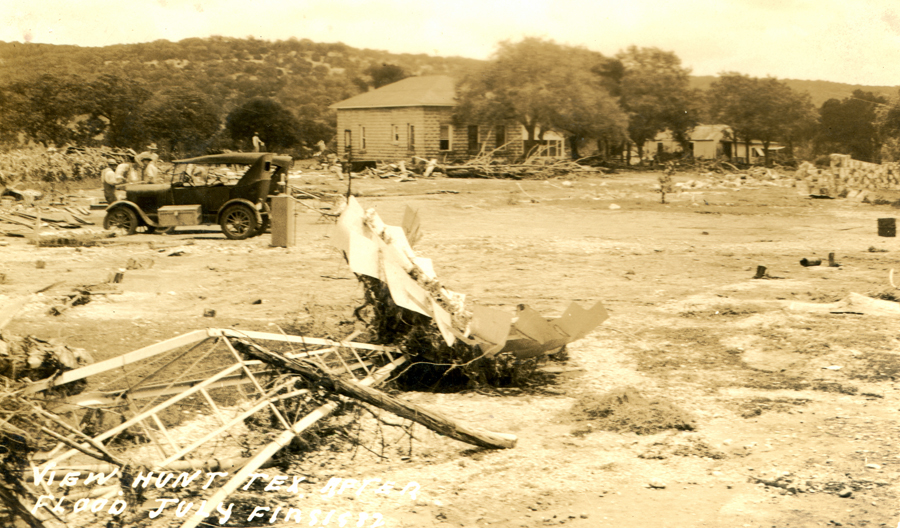
Those of us who've been in Kerrville awhile have seen the Guadalupe River change from its placid, gentle persona into a tantrum-throwing three year old.  My friend Lanza Teague, working with the Kerr County Historical Commission, has put together an exhibit at the Kerr Arts and Cultural Center showing the importance of the Guadalupe River in our community's history.  Here are some photos from my collection showing the flood of 1932 -- the "Big One."  Not only was Kerrville effected, but all the communities along the river -- Hunt, Ingram, Kerrville, and Center Point, in Kerr County, and other communities downstream.
Take time to go see the display at the Kerr Arts and Cultural Center.
Click on any image to enlarge
Tombstones after 1932 flood.
Damage to a home in Ingram, 1932 flood.
Damage in Hunt, 1932 flood.
Damage near Kerrville, 1932 flood.
For more information about Joe's book, please click here.

LinkWithin

Related Posts with Thumbnails