New Kerr County History Book Available!

Thursday, March 31, 2011

Kerrville's Rialto Movie Poster -- 1941

Fred and Annie Streit made an interesting discovery when they were tearing down an old building in Ingram: several old movie posters from Kerrville.  These posters, all from the 1941 season, were underneath a tar-paper cover -- they were used as a sort of underlayment for the wall, possibly during the Second World War when materials were hard to obtain.  There were two movies theaters here in 1941 -- the Arcadia and the Rialto.  The Arcadia is being restored; the Rialto was torn down in the 1970s by the Charles Schreiner Bank, to make a parking lot.  That parking lot is now between Herring Printing Company and Grape Juice.  Thanks to the Streits for bringing these posters by.
Click on image to enlarge
Movie poster, Rialto Theater, Kerrville, August 1941
For more information about Joe's book, please click here.

Wednesday, March 30, 2011

Kerrville Train Station

This picture is in a lot of collections.  I do not have an original, but I'm still looking for a good one.  This station preceded the one now serving as Rails a Cafe at the Depot.   I like this image; the ladies look pleased to have their photo taken.  I like their hats.  I also like the architecture of the old station.
If any of you have a good image of this old station and would share it with me so I can capture a high-resolution scan, I'd appreciate it.
Click on image to enlarge
Kerrville Train Station, Schreiner Street, probably around 1900
For more information about Joe's book, please click here.

Tuesday, March 29, 2011

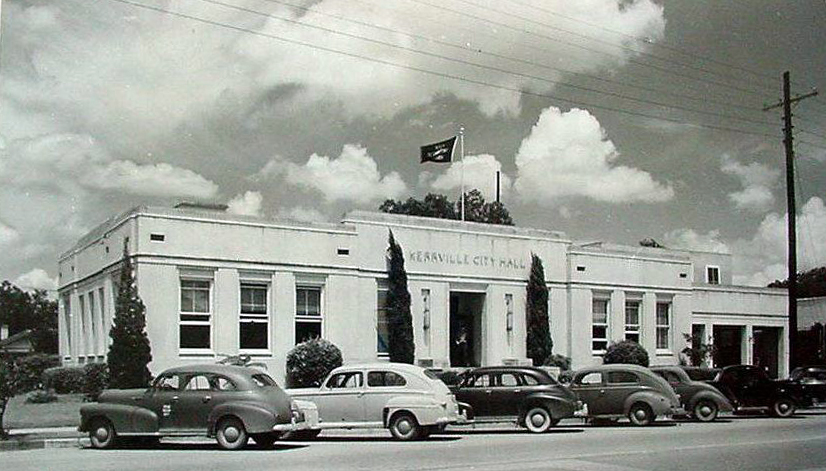
Kerrville City Hall

With the possible movement of the Kerrville City Hall from Junction Highway to the corner of Main and Sidney Baker, where the Sid Peterson Memorial Hospital recently stood, I realized I'd never published any of the photos of the old City Hall -- the one before the current one -- on this blog.  The old City Hall was renovated and became the Union State Bank, there in the 600 block of Main Street. My thanks to Lanza Teague for sharing these images with me.
Click on any image to enlarge
Kerrville City Hall, around 1937.  I think if you look at the far left of this photo,
you can see the Union Church, when it was on Clay Street.

Kerrville City Hall, around 1937.  Photo by Starr Bryden.

Kerrville City Hall, sometime in the 1940s, I guess.  Note the flag atop the building.,

For more information about Joe's book, please click here.

Monday, March 28, 2011

Spies? Who was that couple in Fort Davis?

At first I thought they were dangerous spies, the couple I saw down the porch, chatting together in hushed voices. I imagined I overheard a thick Russian accent and I thought I glimpsed an attaché case filled with maps and spy gear. My over-active imagination was wrong, of course; they weren't spies. But it was true they were on a mission.
I saw them this past summer, when Carolyn and I spent some time in Fort Davis, Texas. We usually go to Fort Davis at least once a summer to escape the heat and visit our friends there. We've been to the little town so many times it feels like we know most of the 1050 people who live there, including the bearded man who shuffles up and down the street singing to himself, and who, despite his appearance, is not homeless, but in fact has both a home and an advanced degree in mathematics. We know the clerks at the grocery store, business owners up and down the main street, and some folks there who run the Prude Ranch summer camp for children.
Our friends Joe and Lanna Duncan own the historic Hotel Limpia, there by the Jeff Davis County Courthouse, as well as other lodging and guest houses in Fort Davis, including the Stone Village Motel.
Until last summer, we'd never stayed at the Stone Village Tourist Camp. It dates from the travel court days, when motels (and automobiles) were a new concept. The Duncans have restored the vintage motel, putting in modern conveniences, and even experimenting with some "camp rooms" which are screened porches with rustic but comfortable furniture.
Since we were meeting Carolyn's family there for a reunion, we chose Stone Village as our "home base" for our visit, though none of us dared the "camp rooms."   Carolyn's parents even rode Amtrak's "Sunset Limited" from Houston to Alpine, where we picked them up at the Alpine station.
Despite being surrounded by family, I kept an eye on that couple down the porch. They were awfully intriguing. They were staying in one of the "camp rooms," were early risers, consulted with each other over coffee, then headed out, not returning until after dark.
Click here for more information
Finally curiosity overcame my natural shyness, and I struck up a conversation with the fellow. Turns out he had no Russian accent at all. They live in Austin. He was writing a book about the area and he and his wife were traveling every day to the principal cities in the region as part of the research for the book.
And that's how I met Byron Browne and his wife Angie. We talked about writing and deadlines (he writes a column, too), talked about the loveliness of the Davis Mountains, and after our first visit, when I confirmed they were not spies, we spoke almost every day.
A few weeks ago I got a copy of Mr. Browne's book, "Driving Southwest Texas."  Man, it's good!   The couple not only did their research, but took some great photos, too. And they're unfailingly nice in the book.
Reading the book is like traveling through the region with a good friend, one who introduces you to the right people and helps you find your way. I heartily recommend the book to anyone interested in the Big Bend Country of Texas. I learned a lot about Fort Davis -- even though I've been there often and thought I'd visited every forgotten corner of the place. Before your next foray out west, get a copy of Browne's book. You'll be glad you did.
Until next week, all the best.
This column originally appeared in the Kerrville Daily Times March 26, 2011.

Friday, March 25, 2011

Heart o' The Hills Inn, Hunt.

I recently came across this postcard showing the Heart o' The Hills Inn in Hunt.  This later became Heart o' The Hills Camp for Girls.  This is a very early image of the building, which was built in 1928 by E. J. "Doc" Stewart, who also founded Camp Stewart for Boys and Camp Stewart for Girls (now called Camp Mystic).  The Heart o' The Hills Inn was built for parents of the summer campers.  Since Stewart's name is on the reverse of the card, and since he died in 1932, I guess this postcard is from around 1930.
Click on any image to enlarge
Postcard, Heart o' The Hills Inn, Hunt, around 1930

Heart o' The Hills postcard, reverse side
For more information about Joe's book, please click here.

Wednesday, March 23, 2011

Kerrville City Hall to move to Sid Peterson Memorial Hospital site.

Today's headline in the Kerrville Daily Times reads "Architect hired for downtown city hall," and the story that follows reports, after a contentious council meeting last evening, where citizens voiced their opinions pro and con about the proposed move, the Kerrville City Council voted to accept the land from the Cailloux Foundation.  They also approved a contract with local architect Peter Lewis to design the new city hall.
In an effort to provide up-to-date information about this issue (and without taking a side in the continuing controversy), I'll repost here some concept drawings prepared by Lewis for the Cailloux Foundation several months ago.  These drawings are to show a concept only, and the final building may well look quite different from these drawings.
Click on any image to enlarge


In addition, my friend Aaron Yates has posted a video of the December Kerrville City Council meeting where the Cailloux Foundation originally offered the land to the City.  To see the video, click here.

For more information about Joe's book, please click here.

Chester Nimitz and Governor Coke Stevenson in Kerrville, 1945

Steven Meeker sent along this image, taken by his mother during the Nimitz Day celebration held here at the end of World War II.  For those who don't remember, Fleet Admiral Nimitz received the Japanese surrender on the deck of the U.S.S. Missouri in Tokyo Bay.  After the war, Nimitz returned to Kerrville for a big celebration in his honor.  While Fredericksburg claims Nimitz (he was born there), it's important to realize Nimitz was raised in Kerrville and attended public schools here from first grade on.  His mother and step-father are buried here, along with a brother.  So, despite Fredericksburg's claims, Chester Nimitz was a fighting Tivy Antler!  Thanks Steven for sending this image!
Click on image to enlarge
Texas Governor Coke Stevenson holds the reins
while Fleet Admiral Chester Nimitz hangs on,
Kerrville, October 1945

Inscription on back of the photo, Jerrie Meeker.

Tuesday, March 22, 2011

A game: how many mistakes are on this Kerrville postcard?

This is the image of an old Kerrville linen postcard -- printed sometime between 1935 and 1949.  But I think it has a lot of errors.  Let's make it a game: if you see an error, please add it to the comments below.   Thanks to Susan Sander for the loan of this image.
Click on image to enlarge
Linen postcard, Kerrville, showing the Sidney Baker Bridge, around World War II.

Monday, March 21, 2011

Kerrville's Notre Dame Catholic Church celebrates 100 years as a parish.

For the past century, the parish of Notre Dame Catholic Church has been a positive force for good in our community.   In fact, a historical marker is being dedicated by the parish Saturday morning, March 19th, at 10:30 in front of the church.  Everyone is invited to the marker dedication.
Although Catholic services had been held here before 1911, most notably in a little frame church on Jefferson Street (behind the present-day Cailloux Theater) called St. Mary's, it wasn't until the congregation had a resident pastor that the church became a parish church.
The arrival of Father Henry Kemper marked a large change for the Catholic congregation here. Fourteen visiting priests preceded him in Kerrville; Kemper, however, made Kerrville his home, and led the parish for 44 years.
He was no ordinary priest, either, holding bachelors and masters degrees from Notre Dame University, and having studied in Rome for the priesthood. He also taught for a time at the University of Chicago. The son of a wealthy Chicago family, Kemper seemed destined for big things in the Catholic Church.
But, it seems, his heavenly Father had other plans. In 1910, Kemper contracted tuberculosis. This changed everything, and ended the scholarly part of his life. He was ordained in Chicago and ultimately sent to a sanitarium in Boerne to recuperate.
In those days the only treatment for tuberculosis was fresh, dry air. Many a family in Kerrville can trace their family's move to Kerrville to a relative who was ill with tuberculosis. Thus was the case with Father Kemper.
He came here for his health and decided to stay, becoming the parish's first resident pastor.
His first task was to determine how many Catholics lived in Kerr and some of the neighboring counties, and so he set out, by horse and buggy, to conduct a census. He counted around 500 Catholics living in the area. While out on this task he conducted services in Japonica (now Hunt), Turtle Creek, Harper, Ingram, Center Point, Barksdale, and Morris Ranch.
One of his earliest efforts here was to move the frame St. Mary's church from Jefferson Street to the corner of Main and Washington, the site of the old Ochse store. With help from his father, he bought eight adjoining lots and two houses, and together they built Notre Dame Institute, a school for grades 1-12. Advertising from the period shows a mortarboard-wearing scholar along with the headline: "One dollar a month and free to the poor."  When the school and parish ran a deficit during tough economic times, Kemper and his family often made up the difference.
In 1915, with help from his father and other community leaders, Kemper established a Catholic church and school dedicated to serving Hispanic parishioners, Our Lady of Guadalupe, on Jefferson Street.
He was also a community leader: In 1923, Kemper was chairman of the Kerrville committee sent to San Antonio to urge the establishment of the American Legion Hospital (now the Veterans Hospital).
In 1935, again with financial help from his family, a larger concrete and stucco church was built to replace the wooden chapel; the Kempers provided $25,000 of the structure's $30,000 cost. At that time the parish changed its name to "Notre Dame" in honor of Kemper's alma mater.
When he died in 1957, the community noted his service as both a religious and civic leader.
Numerous other ministries have begun at Notre Dame, including the St. Vincent de Paul Society, the Knights of Columbus, and the Raphael Community Free Clinic. In addition, the Notre Dame campus has also grown, with a social center, a new gymnasium, and a new sanctuary.
Happy 100th Birthday, Notre Dame!  What an example of giving and leadership you have been in your first 100 years here.
This column originally appeared in the Kerrville Daily Times March 19th, 2011.

Friday, March 18, 2011

Peterson Auto, Kerrville, around 1950

Steven Meeker sent along this image of Peterson Auto, which was on the corner of Sidney Baker and Water Streets.  The large archway on the corner allowed Kerrville Bus Company buses in and out; the corner also served as the bus station for town.  Nothing remains of this once-thriving place.  In its place now stands the parking building which once served the Sid Peterson Memorial Hospital; a lonely, flagless flag pole is on this corner.
We used to go over there as kids for a Coke when the print shop's Coke machine was empty.  It was a very busy place.
Click on image to enlarge
Peterson's Auto, Kerrville, around 1950, on the corner of Water and Sidney Baker Streets.
Taken from the Pampell's corner, looking north.

Thursday, March 17, 2011

Little boy, water front, Louise Hays Park, 1950s

This lad poses in a similar bathing suit to one I wore at about the same age.  Not sure why my parents thought such shots were so photogenic.  The ones of me, rest assured, will not be  posted here.
In the background you can see others enjoying the river.  The sign on the tree reads "No Swimming in River Channel," whatever that means.  Perhaps to keep you out of the props of the boats that flew around in that little "lake" in Louise Hays Park.  Of interest in the shot is the construction of the swimming area as it is today.  The building in the background is the old Ice Plant which was part of the water-mill works years earlier.  Note the nice brickwork near the top of the building.  Would have made some interesting offices, with a nice view of the river.
Click on image to enlarge
Semi-clad lad, Kerrville's Louise Hays Park, mid-1950s

Wednesday, March 16, 2011

Aerial view of Kerrville, possibly mid-1950s

I like this shot of Kerrville, though I need to rescan it to try to enhance the sharpness.   Note how the hospital has the gas station on the first floor, the park is built, though undeveloped, and the curve of the Schreiner company buildings (in the same block as the hospital), curved to allow for the old railroad spur that connected that block with the railroad lines on North and Schreiner streets.
Click on image to enlarge
Aerial view of Kerrville, mid-1950s, looking south.

Tuesday, March 15, 2011

Bleachers, Ski Show, Louise Hays Park, Kerrville

I vaguely remember these bleachers in the Louise Hays Park between the Sidney Baker Street bridge and the little dam in the park, on the park side of the river.  This photo shows the bleachers and a span of the old bridge, too.  Thanks to Susan Sander for loaning me this photograph.
Click  on image to enlarge
Ski show bleachers, old Sidney Baker Street bridge, Kerrville, probably late 1950s.

Monday, March 14, 2011

A place called Pebble, Texas

It might surprise you to know I collect Kerrville and Kerr County items. When I saw an old postcard with the caption "Wagon Train, Kerrville, Tex.,"  I added it to my collection.
The little card is interesting in its own right. Printed on thick card stock, it shows an image of a train of three connected wagons traveling up a slight grade; I can't tell exactly how many horses (or mules) are hauling the wagon, but there are a lot. More than six. You can vaguely see a rider on one of the horses hitched to the wagons. In the distance you can see hills.
Click on any image to enlarge
Postcard, Wagon Train, Kerrville, around 1915
Of course, I bought the card for this picture, even though it was poorly printed. Freight traveled this way before the world saw Interstate highways and railroads. Even after

Sunday, March 13, 2011

Boats in Guadalupe River at Louise Hays Park

It's true folks, people used to ski in the little widening of the river caused by the narrow dam at Louise Hays Park.  Just yesterday someone told me they didn't believe it.  I keep getting photos of boats and skiers down there.  And I remember riding in my parents' boat while they skied there.  So... I think it happened.  Maybe.
Thanks to Susan Sander for loaning me this photo.
Click on image to enlarge
Swirling up the Guadalupe River at Kerrville's Louise Hays Park, mid-1950s

Saturday, March 12, 2011

The Blue Bonnet Hotel

This postcard image of the old Blue Bonnet Hotel is a little creepy.  The hotel used to stand at the corner of Earl Garrett and Water Streets, across from where Francisco's Restaurant is today.
What I find creepy about this postcard is this: it's supposed to be of the hotel at night.  See how the lights are shining in the rooms?
But there are a lot of heavy shadows in the image -- shadows from the balconies high up on the hotel, shadows beneath the cars.  It's a full moon, you might say.  Maybe.  Or a black and white photo of the hotel -- taken during the daytime -- and then weirdly colored to look like an image taken at night.
Ok, maybe it's just me.  What do you think? Is this a little creepy looking?
Thanks to Susan Sander for loaning this image to me.
Click on image to enlarge
Postcard, Blue Bonnet Hotel, Kerrville, around 1950.

Friday, March 11, 2011

A public display of some of my historic photographs of Kerrville

The good folks at Hastings' Hardback Cafe are letting me display some of the photographs from my collection there for a while.  Some of them have never been displayed before.  I hope you'll get to stop by to see them.
Click on image to enlarge
One wall of the display of my photographs, at Hastings on Water Street in Kerrville.

Thursday, March 10, 2011

Kerrville's Notre Dame Catholic Church celebrates 100 years -- part 3

In celebration of Notre Dame Catholic Church's centennial, to be celebrated this coming Saturday, March 19, 2011, with the dedication of an historical marker, I thought I'd present a few images from the parish's past.  This is from a postcard loaned to me by Sandy and Jon Wolfmueller.
Click on any image to enlarge
Postcard, Notre Dame Institute Library, Kerrville, around 1923.  Note Chicago banner.

Reverse of postcard, signed by Father Kemper

Wednesday, March 9, 2011

Kerrville's Notre Dame Catholic Church celebrates 100 years -- part 2

In celebration of Notre Dame Catholic Church's centennial, to be celebrated this coming Saturday, March 19, 2011, with the dedication of an historical marker, I thought I'd present a few images from the parish's past.  This is from a postcard loaned to me by Sandy and Jon Wolfmueller.
Click on any image to enlarge
Postcard, Notre Dame Institute, Kerrville, 1923

Reverse of Postcard

Tuesday, March 8, 2011

Kerrville's Notre Dame Catholic Church celebrates 100 years -- part 1

In celebration of Notre Dame Catholic Church's centennial, to be celebrated this coming Saturday, March 19, 2011, with the dedication of an historical marker, I thought I'd present a few images from the parish's past.  This is from a postcard loaned to me by Sandy and Jon Wolfmueller.
Click on any image to enlarge

Postcard of interior, St Mary's Catholic Church, later renamed Notre Dame, Kerrville, before 1934.

Back of postcard, signed by Father Kemper

Monday, March 7, 2011

Mack's Popcorn Stand

I've noticed something interesting in my collection of photographs. First on Water Street, between the site of the old hospital and Schreiner's, and then later on Earl Garrett, across from the courthouse. I see a sign for an unusual business: "Mack's Popcorn Stand."
I decided to investigate, and found the following information in the "Kerr County Album," published by the Kerr County Historical Commission in 1986.
"Lloyd C. McCoun, Sr., and his wife Jim, and their three children LaVerne, Mary, and Lloyd, Jr., moved to Kerrville in 1932 from Shreveport, Louisiana where Mr. McCoun had been a tile and marble contractor."
He came here to do the same work (actually doing the tile work at the Butt family's homes on Earl Garrett, now the offices of the H. E. Butt Foundation, and also at the Blue Bonnet Hotel), but found, during the Great Depression, work in his field was hard to find.
"At that time, everyone had a nickel, but not a dollar," so McCoun decided to go into the small cash goods business, selling popcorn, and roasted peanuts.
"Mr. Mack, as everyone started calling him, put up his first popcorn and peanut stand on Water Street next to the old J. C. Penney store. At that time the St. Charles Hotel was still standing and took up the corner of Water and Sidney Baker streets. Later he enclosed the popcorn stand and added soft drinks, marble machines, candy, magazines, newspapers, ice cream, and, on special occasions, fireworks. The American Pure Milk Company, which was owned and operated by Carl and Jack Peterson, furnished the ice cream and they were quoted as saying Mr. Mack put them in the ice cream business as he sold all flavors by the cone, pint, and quart.
"Mack's Popcorn Stand was a place to go visit old friends and he welcomed each and every one. The Arcadia Theater did not sell refreshments, so Mr. Mack would pop fresh corn as the children would line up to go into the movie. Needless to say he sold out.
"Mr. Mack said he popped enough corn to bury a city block, and many a bag of popcorn or peanuts would find its way onto an office desk."
He was enterprising: he also had a trailer which he took to fairs and public events.
I'm not sure why I find this story so charming.
Perhaps it's because it represents a simpler time, when a family could support themselves selling popcorn and snacks to children, office workers, and movie-goers. It was a forgotten time when movies didn't have concession stands, but relied upon ticket sales alone, even though they only showed one movie per week, and the movie was several weeks or months old.
Several folks I know remember the old popcorn stand and Mr. McCoun. Like the Cascade Pool, the Rialto Theater and other long-gone businesses which focused on young people, many Kerrville folks have very fond memories of Mack's Popcorn Stand. It was a part of their childhood, a golden memory of times gone by.
Until next week, all the best.
Joe Herring Jr. is a Kerrville native who prefers peanuts to popcorn, but would have been a steady customer of Mack's. This column originally appeared in the Kerrville Daily Times, March 5, 2011.

Sunday, March 6, 2011

A reminder: don't put your hands under rocks.

This photo was loaned to me years ago by John M. Mosty.  It shows a string of snakes, shown off by two men in jackets.  The photo was taken at the corner of Water and Earl Garrett streets, though I'm not sure of the date.  Even though it's cold (the men are in jackets), it's obvious the snakes were around.  So let that be a lesson to you, city kids. Them snakes are purt near everywhere.
Click on image to enlarge
A string of snakes, shown on Earl Garrett Street.  No automobiles behind the pair.  Date unknown.

Saturday, March 5, 2011

Jimmie Rodgers in Kerrville

Love this old photo of Jimmie Rodgers, standing next to his car.  For those that don't know, Rodgers lived in Kerrville for a while, up at "Blue Yodeler's Paradise," on Main Street.  I noticed the spare wheel (by Jimmie's right hand) says Kerrville.  A closer look says "Cone Car Co."  Any ideas where this might have been taken?
Click on image to enlarge
Jimmie Rodgers, Kerrville, possibly the late 1920s.

Wednesday, March 2, 2011

Wednesday Ephemera: "Sketch of Possibility" 700 Block of Water Street, Kerrville

A friend brought by this sketch of the 700 block of Water Street in Kerrville.  I think it might be from the 1930s, but you might have a better idea.  The original sketch is 8x29 inches, and bears the legend: "Sketch of Possibility of Water Street Improvement, sponsored by the Kerrville Chamber of Commerce, Alphonse W Malin, Architect, Kerrville, Texas.  The original will be displayed at our print shop (615 Water Street) for a few days.
Click on image to enlarge
Proposed improvements, 700 Block of Water Street, around 1935.

Tuesday, March 1, 2011

Tuesday Then & Now: the Blue Bonnet Hotel

This old photo of Kerrville's Blue Bonnet Hotel was recently sent to me by Steven Meeker.  I went down to the riverbank to see how much the view had changed.  
Click on image to enlarge
Kerrville's Blue Bonnet Hotel from Louise Hays Park, probably 1950s.
The scene today.  Note the trees.

AddThis

LinkWithin

Related Posts with Thumbnails