Don't miss a thing! Get free updates by email.

Saturday, April 30, 2011

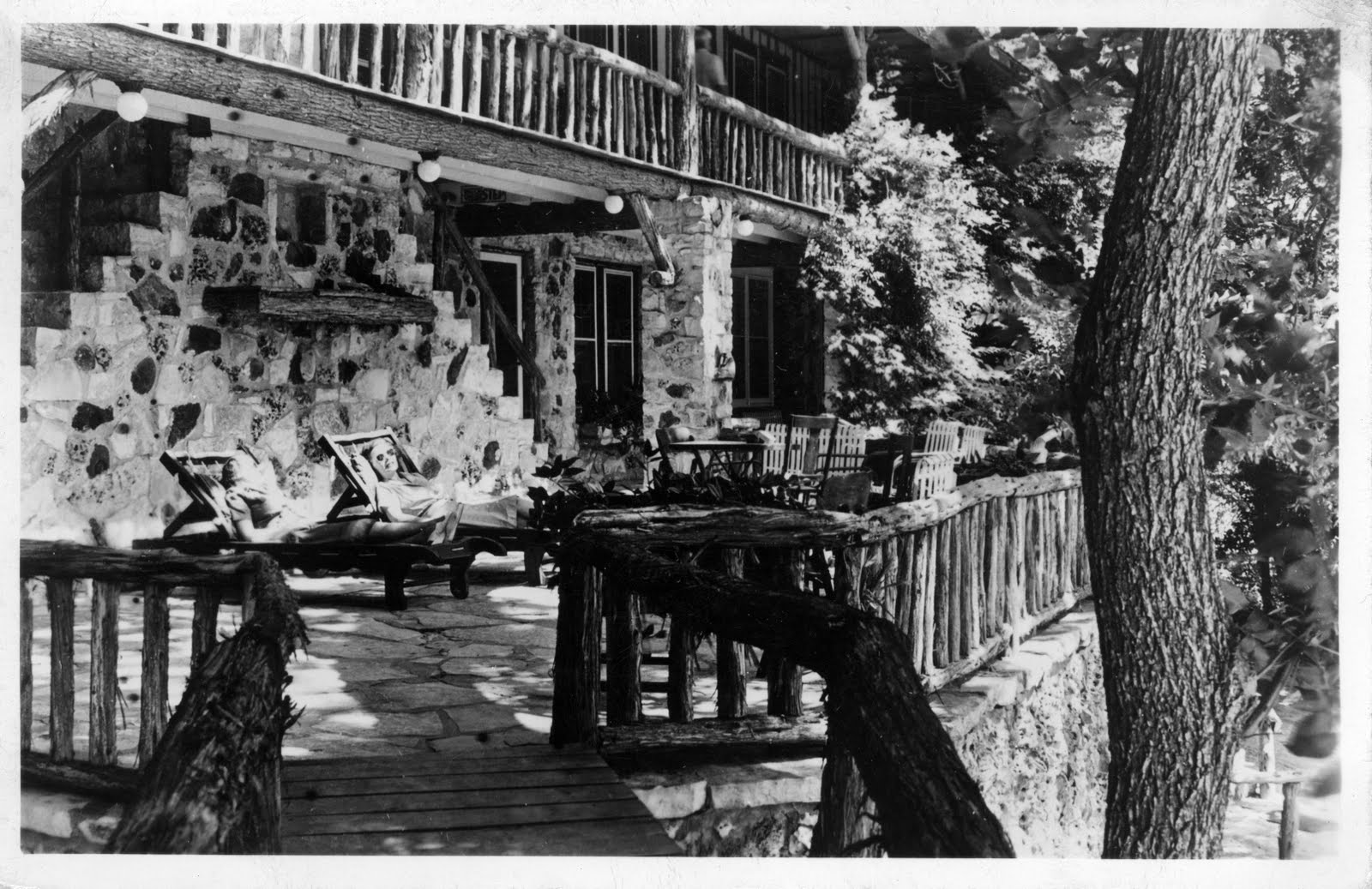
Heart o' The Hills Inn, Hunt, close up views.

One of my favorite places in Kerr County is the Heart o' The Hills Camp for Girls, mainly because of my friend Jane Ragsdale and her family.  This beautiful old landmark is on the south fork of the Guadalupe River, just beyond Hunt, Texas.  Before the site was a girls' camp, however, it was an inn.  Built by "Doc" Stewart, who also founded Camp Stewart for Boys and Camp Stewart for Girls (now Camp Mystic), the Heart was originally designed as a place for parents to stay while their kiddos were at camp.  Here are some rare "close up" images of the place.   I love the old furniture.
Thanks to Lanza Teague for sharing this image with all of us.
Click on image to enlarge
Postcard, Heart o'The Hills Inn, Hunt, late 1940s.
Postcard, Heart o'The Hills Inn, Hunt, date unknown.
For more information about Joe's book, please click here.

Friday, April 29, 2011

An Arbor Day image that's also a big mystery

To celebrate Arbor Day, I thought I'd post a peaceful image, with trees and the river.
Turns out this image, with the three ladies resting in the shade, while a lone hiker walks toward the bridge, is very peaceful.  But I have no idea where it was taken, or even if it's really from Kerrville.  Perhaps one of you history sleuths out there can shed some light on this image.  That bridge is really intriguing.
Happy Arbor Day!
Thanks to Lanza Teague for sharing this image with all of us.
Click on image to enlarge
Postcard, place unknown, bridge unknown, but marked Kerrville, Tex.
For more information about Joe's book, please click here.

Thursday, April 28, 2011

Heart o' The Hills Inn, Hunt, another view (with horses!)

One of my favorite places in Kerr County is the Heart o' The Hills Camp for Girls, mainly because of my friend Jane Ragsdale and her family.  This beautiful old landmark is on the south fork of the Guadalupe River, just beyond Hunt, Texas.  Before the site was a girls' camp, however, it was an inn.  Built by "Doc" Stewart, who also founded Camp Stewart for Boys and Camp Stewart for Girls (now Camp Mystic), the Heart was originally designed as a place for parents to stay while their kiddos were at camp.  Here's another image of the place.  Thanks to Lanza Teague for sharing this image with all of us.
Click on image to enlarge
Postcard, Heart o'The Hills Inn, Hunt, early-1930s
For more information about Joe's book, please click here.

Wednesday, April 27, 2011

Purslay's Service Line -- Kerrville

If you pulled out your Kerrville phone book and looked up "Jitney Station," I imagine you'd have a hard time finding one.  But this photo -- with the handwritten inscription "Purslay's Service Line -- Kerrville's Pride," shows three top-notch drivers and their iron steeds, ready to take you wherever you needed to go.  By the way, the little sign in front of the door says "Jitney Station, Ph[one] 260.  I dialed this number, but no one answered.
Thanks to James Partain for sharing this with me.
Click on image to enlarge
Purslay's Service Line, Kerrville, around 1920.
The "Jitney" service looks to be on Earl Garrett Street, between the Masonic Building (now Shefall's Jewelers) and the Weston Building (now Francisco's Restaurant).  Oddly enough, the little building next to the Jitney Station appears to be Self's Jewelers, but it's obviously in a different and larger building than before.  Note the little clock sign. It's the same as pictured elsewhere on this blog.

For more information about Joe's book of historic photographs, please click here

Monday, April 25, 2011

The Comedy and Tragedy of the Arcadia Theater

The Arcadia Theater, Kerrville, late 1920s.
With the Arcadia Theater in the news lately, I thought it might be useful to share the old girl's history here again.
According to the reports I've read, the plans for the renovation of the Arcadia have little to do with the history of the building. The City of Kerrville felt it best to sell the historic theater to a person with a history of successful businesses. That person has now partnered with a successful builder. Hopefully this new incarnation of the Arcadia will be a success, too.
I'll admit I was a little dismayed at some of the things proposed for the facility, including leveling the floor and the installation of icons and images from New York City. The first will make it difficult to ever return the Arcadia to a performing arts site; the second, images from NYC, have nothing to do with Kerrville, or of the history of the Arcadia.
But enough of my soapbox; here's a little history of the Arcadia from my files:
On the warm Tuesday evening of June 29, 1926, a flock of folks crowded into a newly built hall to watch the comedy film “Irene,” starring Colleen Moore. They were greeted with “cooled” air and a saga about the life of a poor, beautiful Irish lass

Sunday, April 24, 2011

Another view of Self's store, Kerrville

Happy Easter, everyone!
Here's another view of Self's store which I'd never seen before.  I'm thankful to James Partain for sharing this with me.  I really like the typography over the little porch on the building, and I have a different view of this building hanging by my desk at our print shop. In this image, you can see items for sale in Mr. Self's store.  This store was later on Water Street, between the Arcadia and the Charles Schreiner Bank, in the 700 block.
Click on image to enlarge
Self's, Earl Garrett Street, Kerrville.
Note ads for Edison gramophones on wall to right. 
For more information about Joe's book of photographs 
of Kerrville's past, please click here.

Saturday, April 23, 2011

Self's Store, on Earl Garrett Street in Kerrville

Of all of the photographs I have in my collection, I chose one to hang by my desk at the print shop.  It shows a muddy Earl Garrett Street (then called Mountain Street), the Masonic Building (now the home of Sheftall's Jewelers) and a little frame shop with large lettering: "SELF."  It was one of the first images I collected, and I love the typography on the building, the clock hanging from the awning.
But my friend James Partain brought by a better copy of the image, one that shows a lot more detail.  In my copy, you cannot see into Self's store; you cannot see a man under the porch of the Masonic Building; you can't see the sign reading "Post Office" under the Masonic Building awning.
I'm blown away by the details I'd never seen before.
Click on image to enlarge
Masonic Building and Self's, Kerrville, around 1900
To order Joe's book of Kerrville historical photographs, please click here.

Friday, April 22, 2011

Captain Schreiner's greenhouse.

The maps I'm always mentioning -- Sanborn-Perris maps -- show a greenhouse next to Captain Charles Schreiner's house, where the post office was later built, on the site now occupied by the Kerr Arts and Cultural Center.  I've often wondered about the greenhouse -- and, thanks to James Partain -- I now can see what his greenhouse looked like.
Click on any image to enlarge
Stereoscopic image of Captain Schreiner's home on Earl Garrett.
Note greenhouse on far right of image.
Looking up Earl Garrett Street (then called Mountain Street), around 1915.
Note Schreiner's greenhouse on left side of image.
For more information about Joe's book, which has over 200 historic photographs
 of Kerrville, please click here.

Thursday, April 21, 2011

Another early view of Kerrville from the Tivy Hotel

Here's another shot of Kerrville taken from atop the Tivy Hotel.  The Tivy Hotel was at the corner of Main and Tivy Streets, though in the old days it faced Main Street instead of Tivy Street as it does now.  Thanks to James Partain for sharing this image with me.
Click on image to enlarge
Kerrville from "Tivy House," probably around 1900
For more information about Joe's book, please click here.

Wednesday, April 20, 2011

Wednesday Ephemera: 1914 Tivy Graduation Program

Special thanks to my fellow history enthusiast Jan Wilkinson for sending this along to share with everyone.  Not only is she a descendant of the founder of Kerrville, Joshua Brown, she's also a blogger.  You can learn a lot by visiting http://blog.wilkinsonranch.com.
This program for the 1914 graduation is very interesting.  First, there are some very interesting names in the class, including Ms. Wilkinson's relative Gussie Mae Brown.  Secondly, look how many activities were planned for the community celebration!
Thanks Jan for sharing these with all of us.
Click on any image to enlarge


For more information about Joe's book, which includes
 a few images of Gussie Mae Brown and her family, please click here.

Tuesday, April 19, 2011

Tuesday Then & Now: the Union Church

The Union Church has a long history in our community, built in 1885.  At a time when Kerrville had no churches, a group of ladies, traveling from house to house on horseback, raised enough money for a church to be built.  It was named the Union Church (at a time when the wounds of the Civil War were still relatively fresh in the South) because four different congregations shared the building: the Presbyterians, Baptists, Christian Church, and Methodists.  Through the hard work of the Kerr County Historical Commission, and especially Julius Neunhoffer, the building was restored and moved to the corner of the Schreiner University campus.  (When I was a boy, the structure was on Lemos Street, and housed an Army/Navy Surplus store.)
Click on any image to enlarge
The Union Church building, when it was on Clay Street,
facing what is now Union State Bank, Kerrville, late 1940s.
Restored Union Church Building, Kerrville, 2011
Walking through Kerrville today it's hard to travel far without hitting a church yard; they are especially congregated in our Old Town section. It wasn't always this way. Although preaching has been going on in our community for a long, long time (starting with the first preacher here,

Monday, April 18, 2011

Finding "Split Rock," an early Kerrville landmark

I have in my collection of Kerrville and Kerr County historical items several postcards from the turn of the last century showing a local landmark: Split Rock.
Postcard, Split Rock, near Kerrville
The postcards show a garage-sized rock split by a tree growing from its center. I have photographs, too. The images also show young people posing on top of the rock, the rock covered with graffiti, most of it commercial in nature. Though there was a fence in most of the photos, people often crossed the fence to climb the rock for portraits.
In addition, I learned the San Antonio and Aransas Pass Railroad had a stop called "Split Rock."  This is the railroad that arrived in Kerrville in the 1880s and really set Kerrville on the path to economic prominence among her neighboring communities.
Here's the thing: I could not find Split Rock. There is a Split Rock Road near Kerrville's Louis Schreiner Field, and, years ago,, when my son was still quite young, I had wandered around out there looking for the old Split Rock. I did not find it and assumed two things: first, that the old landmark was in the river bed and second, that it had washed away in one of our many floods since 1900.
Of course, like most of my assumptions these were wrong. I had visited the area where I thought the rock might be several times in the past two decades, but never could find the old stone. Comfortable in my assumption, I stopped the search.
Postcard, Split Rock, near Kerrville
Then a printing project at our shop changed my theory. Ruth and Frank Kiel ordered some of their well-written travel guides, a self-guided tour of the Guadalupe River Valley between Kerrville and Comfort. (Copies of the booklet are available at Wolfmueller's Books.)  I noticed a photograph of Mr. Kiel standing next to a weathered boulder. The caption read "Split Rock."
I immediately pulled out my postcards and photographs. Could it be? 
Comparing the Kiel's photograph with my turn-of-the-last-century images posed a problem, though. The rocks didn't match. They were the mirror-opposite of each other.

Sunday, April 17, 2011

Another view of Kerrville's "Split Rock" landmark

This is typical of many of the photographs of Kerrville's "Split Rock" landmark.  These usually show a grinning young person atop the rock.  It was quite a popular place to pose for photographs at the turn of the last century.  Hard to believe this image is over 100 years old.
Click on image to enlarge
Split Rock, near Kerrville, around 1907.  The young man is probably
Grady Grinstead, son of J. E. Grinstead, who I assume took the photo.

For more information about Joe's book, which features 
over 200 historical Kerrville photographs,  please click here.

Saturday, April 16, 2011

Another postcard showing Kerrville's Split Rock

Here's another postcard showing Kerrville's landmark "Split Rock," a garage-sized boulder split into four pieces by an oak tree in the middle.  This was quite a popular place at the turn of the last century.
Click on any image to enlarge
Postcard, Split Rock, near Kerrville, around 1907

Reverse of postcard
For more information about Joe's book, which features 
over 200 historical Kerrville photographs,  please click here.

Friday, April 15, 2011

Split Rock, Kerrville, a Landmark in the early 1900s

I have a few images in my collection of a long-lost landmark in Kerrville: Split Rock.  There are postcards and snapshots of the rock, a large limestone boulder split by an oak tree.  Most of the images date from the early 1900s.
Click on image to enlarge
Postcard, Split Rock, Kerrville, around 1904
For more information about Joe's book, please click here.

Thursday, April 14, 2011

Mystery building, Kerrville, before automobiles

I have checked my various sources -- maps, old photographs, etc. -- and while I know where this building is located, I'm not exactly sure what it is. The one I'm talking about is the one behind the two wagons with a little taller part in the middle of the facade.  Sure, it's in the location of the Charles Schreiner Bank.  But the bank, while also 2 stories tall, has a completely different window placement.  You'd think if they just covered the old building with brick, the windows would be in the same position for both.
This shot was taken from Earl Garrett Street looking toward Water Street.  The river would be behind the building.
I know the building does not appear in the 1898 or the 1904 Sanborn-Perris maps.
Special thanks to James Partain for sharing this photo with me.
I'd appreciate your guesses in the comments below.
Click on image to enlarge
Wagons on Earl Garrett Street (then called Mountain Street), Kerrville, date unknown.
For more information about Joe's book, please click here.

Tuesday, April 12, 2011

Old Pampell's movie postcard, Kerrville, 1914

Years ago, Pampell's showed movies.  From what I can gather, the movies were shown upstairs, near the back of the building, back before it was a brick building.  These were the very earliest movies, and they were silent.
How did Pampell's advertise the show?  They sent out postcards, like the one below.
Click on any image to enlarge
"Paid in Full" advertising postcard, Kerrville, 1914

"Paid in Full", advertising postcard, Kerrville, 1914. Note purple rubber stamp text.
For more information about Joe's book, please click here.

Monday, April 11, 2011

Good people at the Kerrville Area Chamber of Commerce

Sometimes true character is revealed in stressful times.
This can be both good and bad; adversity tends to highlight both strengths and weaknesses. In a tough situation, some may shrink away from their duty, while others rise to unexpected heights.
This column is about the latter: in the past few months I have seen a group of people band together during a transition time and really shine.
One of the organizations I admire in our community is the Kerrville Area Chamber of Commerce. It is unabashedly pro-Kerrville and under the recent executive leadership of my friend Brian Bondy, the chamber really shined.
But when Brian made a great career move and took a new job in San Marcos, the momentum built under his stewardship might have dwindled. Our chamber might have floundered a bit. But it did not.
I credit, of course, the fine staff at the Kerrville Area Chamber of Commerce. Dora, Susan, Kristan and Barbara have continued all of the programs underway with professionalism and enthusiasm. The transition from an old software system to a new, more powerful (and member-friendly) software system has progressed smoothly. A great and informative luncheon featuring new education programs at Schreiner University was held. A much-anticipated golf tournament was successfully produced. (Ask my friend Trevor Hyde about his round during that tournament!)  And each visitor to the chamber offices was warmly greeted and helped.
During this transition time these professionals have done a great job and their work is to be much commended. I think they've grown stronger as a team and have demonstrated great leadership.
There are also some volunteer leaders who've really stepped up during the transition.
Bob Waller, the current chairman of the chamber board, has done an outstanding job. Not only has he assumed a more active role in the day-to-day management of the chamber, but he has led a successful search committee, looking for the next executive of our local chamber. All the members of the search committee have devoted many hours to finding the right person for this important community job.
And Bob has lead this effort with his usual good humor and determination.
If the Kerrville Area Chamber of Commerce didn't exist, we'd need to invent it. Few consider how important it is to have an organization whose purposes are to represent the Kerrville area, to work to make our community a better place, to gather people together for community events, and to give members a productive and effective way to work toward a better future. I think our Kerrville Area Chamber of Commerce builds community while promoting our area.
If you love our community, I know you'll find the chamber a good place to work together with like-minded folks to make the Kerrville area the place we all know it can be.
Until next week, all the best.
This column originally appeared in the Kerrville Daily Times April 9, 2011.
For more information about Joe's book, please click here.

Sunday, April 10, 2011

Two images from J. E. Grinstead

There are several images taken by J. E. Grinstead in my scanned collection.  I believe these images are of Mr. Grinstead and his second wife, Gertrude Wright Grinstead.  They had three children together: a daughter, Bessie; and two sons, Jessie, and Pam; Grinstead had two sons with his first wife, Grady and Doyle.  His first wife died of tuberculosis in Kerrville, soon after they arrived here.  Getrude Wright Grinstead, his second wife, was a widow who owned a boarding house.  I love the old foot bridges.  Wish I knew where these photos were taken.
Click any image to enlarge
J. E. Grinstead, around 1910, location unknown

Possibly Gertrude Wright Grinstead, around 1910, location unknown.
For more information about Joe's book, please click here

Friday, April 8, 2011

Kerrville Times paper boy, late 1950s

I think this photo is great.  I don't know the boy's name, but his dog was named "Mickey." This was before the Kerrville Times changed its name to the Kerrville Daily Times. If anyone can identify this paper boy, please let me know in the comments section below.
Paper boy, Kerrville, late 1950s.
For more information about Joe's book, please click here.

Thursday, April 7, 2011

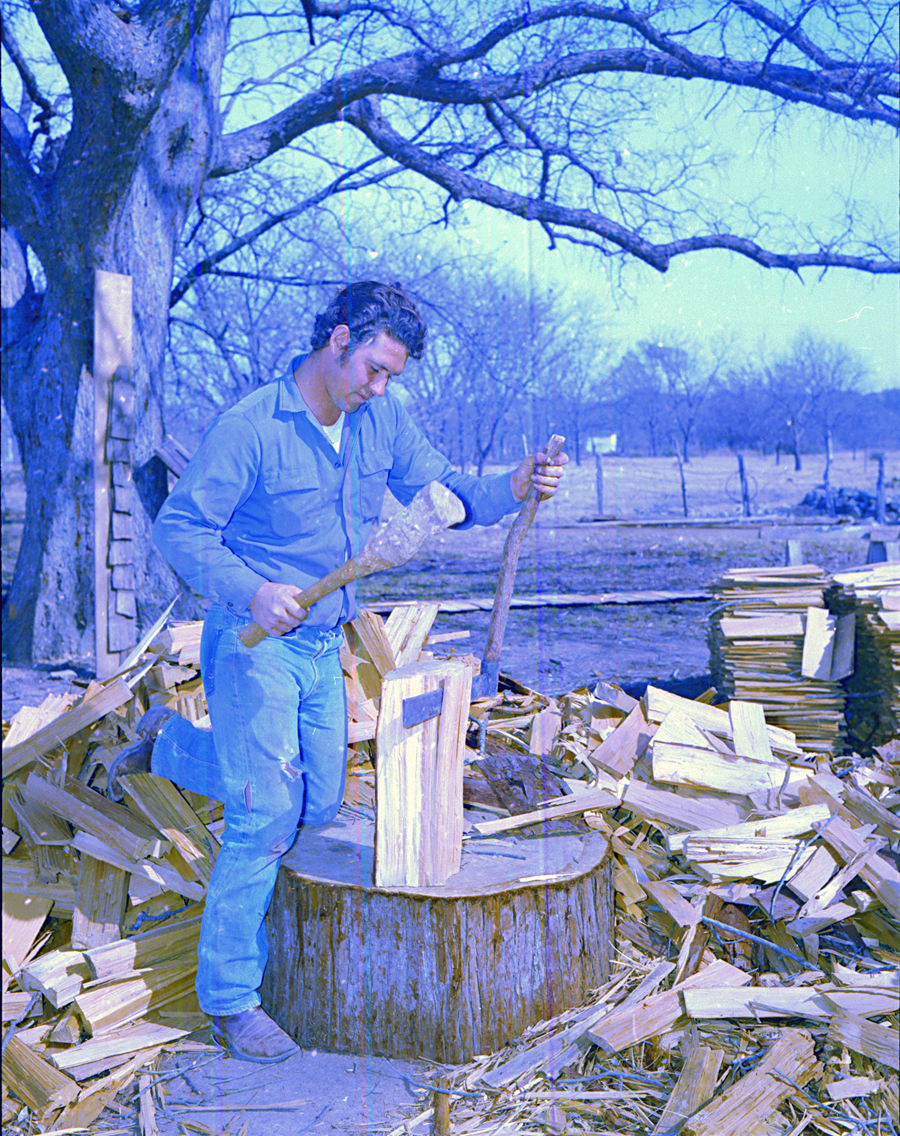
Making Shingles -- How Kerrville got its start in 1846

When I ran across these images, I thought they might be useful to those interested in learning more about Kerrville's history.  You see, Kerrville got its start because a young man named Joshua D. Brown established a shingle making camp here in the late 1840s.  Their idea was to harvest the cypress trees to make shingles.  Cypress has certain oils in it which help it repel water, and so they were good for roofing.
Still, it's hard to envision what the process was like.  Perhaps these photos will help. I believe they were taken near Stonewall, Texas, at the Danz Cabin, which was restored as part of the Lyndon B. Johnson State and National Park.
Click on any photo to enlarge
A section of cypress is cut from a tree.

Slabs were cut by hand from the tree.

The sections were split.
The split sections were cut into shingles using a froe and mallet.
The rough shingles were then shaped into final form with a draw knife.
For more information about Joe's book, please click here.

Wednesday, April 6, 2011

First Texas State Arts and Crafts Fair -- Kerrville, 1972

I've been asked to pull together some photos of the very first Kerrville Arts and Crafts Fair since the organization is producing its 40th fair this season.  This is hard for me to believe.  As with the first Kerrville Folk Festival (same year), I was at the very first Texas Arts and Crafts Fair, too.  My father had a little platen letterpress on which we printed, by hand, the official maps of the fair.  Though I was not supposed to touch the press (I was 9 years old), I do remember printing a few of the maps myself.  Oops.  Probably shouldn't have confessed that.  I'll have more images of the fair as the event gets closer.  In those days the fair was held on the campus of the then-Schreiner College.  (Perhaps Institute; not sure when they changed the name.)
Click on any image to enlarge
First Texas State Arts and Crafts Fair, Kerrville, 1972

First Texas State Arts and Crafts Fair, Kerrville, 1972

First Texas State Arts and Crafts Fair, Kerrville, 1972

First Texas State Arts and Crafts Fair, Kerrville, 1972 
First Texas State Arts and Crafts Fair, Kerrville, 1972
For more information about Joe's 192 page book of historic Kerrville photographs,
featuring more than 200 photos, please click here.

Tuesday, April 5, 2011

A hunting party, Kerr County, around 1905

I thought these gentlemen were slightly overdressed for their excursion, but times change.  I'm not sure where they are, but I'm fairly sure it was here in Kerr County, and from the other images in the set, I'm guessing the images were all taken around 1905.  If you can identify any of the hunters, please let me know in the comments section below.
Click on any image to enlarge
Hunter, Kerr County, around 1905

Hunter, Kerr County, around 1905

Hunter, Kerr County, around 1905
For more information about Joe's book, please click here

Monday, April 4, 2011

Wandering around downtown Kerrville

This past Sunday evening I spent some time wandering around Kerrville's old downtown. It was the perfect time to visit; the streets were empty and I had the place to myself. The sun was low in the sky and lit the buildings in a way I don't remember seeing. Aside from the Kerrville Main Street manager and the owner of Pampell's, there were no people on the sidewalks, either. It gave me some quiet time to really look at the old town and explore some trails I hadn't traveled since I was a boy.
The problem with living in one place your whole life -- at least for the purposes of this column -- is you take things for granted. You no longer see or notice things. It's as if you travel through your memories or perceptions of a place and never stop and see the place.
This realization came to me years ago when the post office was still downtown. Part of my daily ritual was a visit to the post office to get the mail from my box, walking from the print shop, crossing to Pampell's, jaywalking in front of the Arcadia, sometimes cutting through Schreiner's, walking in front of the old Schreiner mansion, then up the steps to the post office. One day on this route I came across a freshly-cut stump in the sidewalk in front of the mansion.
Here's the thing: I hadn't realized there was a tree there. I had walked by it hundreds (perhaps thousands) of times and had not once stopped and looked up at the tree. I only noticed it when it was gone.
Kerrville's downtown has changed a lot since I was a boy. True, it's been a very long time since I was a boy. Let me prove how long ago it was:
I can remember when a train ran down North and Schreiner streets.
I can remember Louis Schreiner, Captain Charles Schreiner's son, working at the Charles Schreiner Bank. Mind you, Louis Schreiner was born in 1870, just a year after his father started the store.
I can remember my parents water-skiing in the little "lake" at Louise Hays Park. Lots of folks skied down there.
I can remember the Bluebonnet Hotel, the Rialto Theater, Pampell's when it was the place to get the best chocolate malts, and Winn's and Penney's all right downtown. I can remember the day they opened the Butt-Holdsworth Memorial Library; that was a big day.
There was a time when I was often the youngest person in the room, especially when I was involved in city government. Those days are long past.
So last Sunday evening it was good to spend some time wandering around downtown. I sat in several of the benches and just looked at buildings and things comparing them to what I assumed about the places. I learned some things that evening, and it was good to visit the places I thought I knew so well.
It's true the only constant is change. The heart of the town I've called home for almost 50 years has certainly changed. But come to think of it, I can't think of a time when it wasn't changing, when some building wasn't being pulled down to make way for a new building rising in the same spot.
Change doesn't bother me, and I hope it doesn't bother you. Sure, I miss some of the people and old places that are now gone, but for as long as I can wander around I'll still carry them in my scattered memory. I'm looking forward to some of the changes planned for downtown.
I'd encourage you to take the same tour I took some evening. There might be some parts of the old downtown you'd forgotten. It's still a happening place.
Until next week, all the best.
This column was originally published in the Kerrville Daily Times April 2, 2011.
For more information about Joe's book, please click here.

Sunday, April 3, 2011

Barbecue Picnics at Louise Hays Park in Kerrville

I remember attending barbecues at Louise Hays Park as a child.  Often they were fundraisers for some group or other, but I remember them fondly.  The tables and pit are still there, but I don't remember attending a barbecue there for many years.  If you can help me identify any of the people in these photos, I'd appreciate it.  Use the comments section below.
Click on any image to enlarge
Cooks, Louise Hays Park barbecue picnic, Kerrville, 1968

Crowd, Louise Hays Park barbecue picnic, Kerrville, 1968

Crowd, Louise Hays Park barbecue picnic, Kerrville, 1968
For more information about Joe's book, please click here

Saturday, April 2, 2011

Mystery Photo Solved -- Building identified!

Thanks, readers, for playing along with my April Fools post from yesterday.  The building below, though marked Kerrville is not from around here.  In fact, I took the photo myself, in Kerrville, Tennessee back in 1998.  We'd taken the kids to Washington, D.C. by car, and on the way back we made a little detour to visit Tennessee's Kerrville.  It was very small -- about the size of Luckenbach -- but it had this building and two churches.  We ate a picnic lunch at the Methodist church, snapped a few photos, and spent the night in Nashville.  Happy April Fools Day!  (That was a gentle little prank, don't you think?)
Click on any image to enlarge
Densford building, Kerrville, Tennessee (not Texas).

Another view, Densford building, Kerrville, Tennessee (not Texas).
For more information about Joe's book, please click here

Friday, April 1, 2011

Mystery Photo -- Can you identify this building?

A friend brought by these two photos of a building marked "Kerrville."  I'm stumped.  Anyone have any idea where this building was?  Please let me know in the comments below.
Click on any image to enlarge
Kerrville mystery building, first view.

Kerrville mystery building, second view.
For more information about Joe's book, please click here.

LinkWithin

Related Posts with Thumbnails